Schizophrenia
Schizophrenia is a long-term mental health condition that affects how a person thinks, perceives and experiences reality, and can cause psychosis, in which it becomes hard to tell what is real1,2,3. Effective treatments and support exist, and many people with schizophrenia recover or live well, although stigma and lack of access to care remain major barriers1.
This information is for education. It is not medical advice and does not replace assessment by a qualified health professional. Anyone concerned about symptoms should consult a doctor; in an emergency, local emergency services should be contacted.
What it is
Schizophrenia is a serious mental illness that affects how a person thinks, feels and behaves2. Clinicians describe it as a type of psychosis3.
It affects about 1 in 300 people worldwide1. Onset is most often in late adolescence or the twenties, and tends to be earlier in men than in women1. Its course varies: some people have symptoms that come and go over their lives, while others experience a gradual worsening1.
People with schizophrenia do not have a ‘split personality’, and most are not violent; they are more likely to be harmed by others than people without the condition2,3. Stigma and discrimination are widespread and can limit access to health care, education, housing and work1.
On average, people with schizophrenia die about nine years earlier than the general population, often because of physical illnesses such as cardiovascular, metabolic and infectious diseases1.
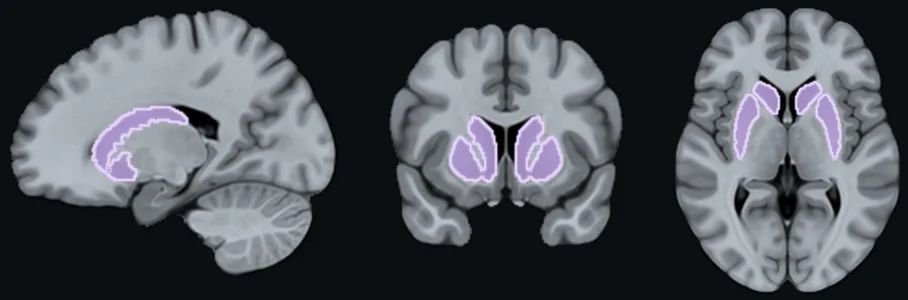
PET imaging has shown increased dopamine function in the striatum, proposed as a final common pathway to psychosis11.
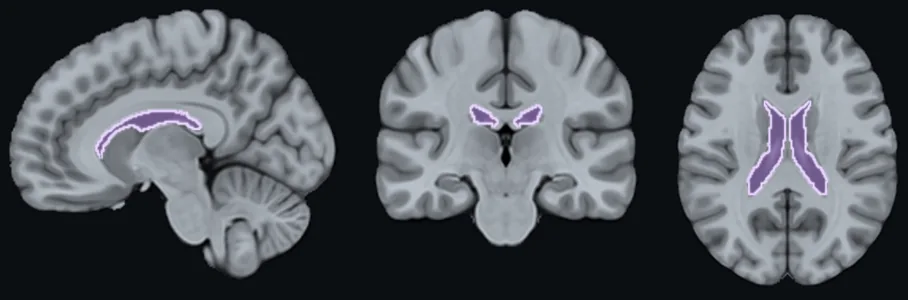
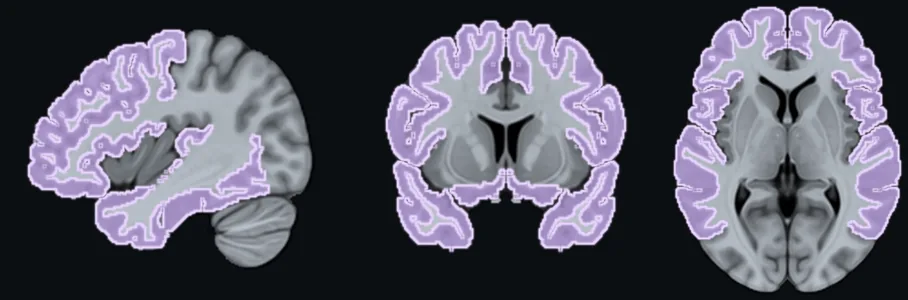
Imaging consistently shows enlarged fluid-filled ventricles and total brain volume about 2% smaller on average5.
Structural and functional MRI reveal differences in frontal, temporal and striatal circuits4,5.
Signs and symptoms
Symptoms are usually grouped as psychotic (sometimes called positive), negative and cognitive2. Gradual changes in thinking, mood and social functioning often appear before the first episode of psychosis2.
- Hallucinations: hearing, seeing, smelling, tasting or feeling things that are not there; hearing voices is common1,2
- Delusions: firm beliefs that are not true, such as believing one is in danger or receiving special messages1,2
- Disorganised thinking and speech, such as jumping between topics or losing the thread mid-sentence1,2
- Experiences that one’s thoughts or actions are being controlled or broadcast by others1
- Negative symptoms: reduced motivation, loss of enjoyment, social withdrawal, and limited speech or emotional expression1,2
- Cognitive symptoms: difficulties with attention, memory and processing information, which strongly affect day-to-day functioning2
- Rarely, catatonia, in which a person stops moving or speaking for periods of time2
Causes and risk factors
No single cause has been identified. Schizophrenia is thought to result from an interaction between genetic factors and environmental exposures, many acting early in life to alter brain development1,4.
Psychosocial stress, such as a stressful life event, can contribute to the onset of symptoms in people who are vulnerable3,4.
- A family history of schizophrenia, although most relatives of people with schizophrenia do not develop it2
- Complications during pregnancy and birth, and exposure to viruses or nutritional problems before birth2,5,11
- Growing up in poverty or in stressful or dangerous surroundings2
- Heavy cannabis use: the heaviest users had about four times the odds of psychosis compared with non-users in one meta-analysis1,10
- Male sex, as schizophrenia is modestly more common in men than in women5
- Living in urban areas and migration, which are linked to differences in rates between regions6
Genetics
Schizophrenia is strongly heritable: a nationwide Danish twin study estimated its heritability at 79%7. Yet when one identical twin has schizophrenia, the other has it in only about a third of cases, showing that genes do not determine the outcome alone7.
The genetic contribution is largely polygenic, involving many variants of small effect5. The largest genome-wide association study, including more than 76 000 people with schizophrenia, found associations at 287 distinct regions of the genome, with genes concentrated in nerve cells and synapses8.
One of the strongest signals lies in the immune-related major histocompatibility complex region, where variants of the complement component 4 (C4) genes that increase brain expression of C4A raise risk9. In mice, C4 helps remove synapses during development, suggesting that excessive synaptic pruning may contribute to the condition9.
What happens in the brain
Brain imaging consistently shows enlarged fluid-filled ventricles and total brain volume reductions of around 2% on average, with altered function in frontal brain regions and in the way large-scale brain networks interact5. Gross brain damage is not a feature; the changes are subtle and affect particular cell populations and cell-to-cell communication6.
The dopamine hypothesis proposes that many risk factors converge on increased dopamine release in the striatum, a deep brain region, which is thought to be a final common pathway to psychosis11. Dopamine is a chemical messenger involved in motivation and reward, and most antipsychotic medicines block its D2 receptors11,14.
Glutamate, the brain’s main excitatory chemical messenger, is also implicated, particularly through NMDA receptors5. An imbalance between excitatory and inhibitory signalling in the cortex may underlie the cognitive and negative symptoms, which current medicines treat less well4,6.
How it is diagnosed
There is no single test for schizophrenia. It is diagnosed after an assessment by a mental health professional, such as a psychiatrist, based on the person’s symptoms, history and course of illness3.
Early assessment matters. In the United Kingdom, NICE recommends that people with possible early signs of psychosis be referred without delay to specialist or early intervention in psychosis services13.
- A comprehensive assessment, by a psychiatrist or psychologist within a multidisciplinary team, of mental health, development, relationships, trauma, social circumstances and work or education13
- A medical history and full physical examination to identify physical illnesses, brain disorders or prescribed or other drugs that may cause psychosis13
- Physical examination and tests to establish baseline health, including weight, blood pressure, blood glucose and blood lipids, before treatment13
- Assessment of cognitive function, which is among the best predictors of daily functioning2
- Assessment of risk of harm to self or others, alcohol and drug use, and co-occurring conditions such as depression, anxiety or post-traumatic stress disorder13
How scientists study it
Consortia analysing the DNA of hundreds of thousands of people have mapped hundreds of risk regions and linked them to synaptic biology8.
Nationwide twin and psychiatric registers are used to estimate heritability and how often identical twins share the diagnosis7.
Structural and functional MRI reveal differences in brain volume and in the activity and connectivity of frontal, temporal and striatal circuits4,5.
Positron emission tomography (PET), which uses tiny amounts of radioactive tracers, has shown increased presynaptic dopamine function in the striatum of people with schizophrenia11.
Mouse studies and human brain tissue have been used to test how risk genes such as C4 affect synapses during development9.
Large cohort and case-control studies examine environmental risks, such as cannabis use, and their dose-response relationships10.
Network meta-analyses compare dozens of antipsychotics across hundreds of randomised trials for effectiveness and side effects12.
Current treatments
There is no cure, but antipsychotics reduce the intensity and frequency of psychotic symptoms and are the mainstay of treatment2,5. Differences in effectiveness between them are mostly modest, whereas side effects such as weight gain, sedation and movement problems differ more markedly12. Some can be given as an injection once or twice a month2.
Indian clinical practice guidelines regard clozapine as the treatment of choice when symptoms persist after adequate trials of at least two antipsychotics16, as does NICE in the United Kingdom13. People taking it need regular blood tests to check for a potentially dangerous side effect that affects 1-2% of them2.
Cognitive behavioural therapy (CBT) for psychosis and family intervention are recommended alongside medicine, although the effects of CBT on symptoms are relatively small5,13.
Coordinated specialty care for a first episode of psychosis brings together a team offering medicine, therapy, family support, and help with education and employment2,13.
Supported employment, skills training and cognitive remediation, which trains attention and memory, help people manage daily life, work and study2,6.
Regular monitoring of weight, blood pressure, glucose and lipids is recommended, because people with schizophrenia have high rates of cardiovascular and metabolic disease and some antipsychotics cause weight gain1,12,13.
A recovery-oriented approach, giving people agency in decisions about their treatment, together with psychoeducation and family support, is considered essential1.
Research frontiers
Xanomeline-trospium, which stimulates muscarinic acetylcholine receptors instead of blocking dopamine D2 receptors, reduced positive and negative symptoms in a phase 3 trial, representing a potential new class of antipsychotic14.
The C4 findings have prompted research into whether excessive elimination of synapses during brain development contributes to schizophrenia, and could help explain the reduced numbers of synapses reported in the brains of people with schizophrenia9.
Because current medicines do little to improve cognitive and social functioning, new approaches targeting cortical excitation-inhibition balance are being explored4,6.
Since schizophrenia begins years before diagnosis, identifying people at high risk and intervening early is a major research goal6,13.
Researchers are using the hundreds of genetic associations to identify specific genes and cell types that could become treatment targets8.
Living with the condition and seeking help
Symptoms such as hearing voices, unusual beliefs or withdrawal from everyday life should be assessed by a doctor as soon as possible; the earlier schizophrenia is treated, the better3. Many people recover, although symptoms may return at times3.
Taking medicine as prescribed, recognising early signs of relapse and talking with others about the condition can reduce the chance of severe relapses3. Medicine should not be stopped without first discussing it with a health professional2. Family education programmes and support groups can help both the person and those who care for them2,3.
If someone is in crisis, is thinking about suicide, or may be at risk of harming themselves or others, local emergency services or a crisis line should be contacted straight away, or the person should go to the nearest emergency department. In India, emergency help is available on 11217, and Tele-MANAS, the national tele-mental health service, offers free support at all hours on 1441618.
References
- World Health Organization. Schizophrenia (fact sheet). 11 September 2026. Link
- National Institute of Mental Health, United States. Schizophrenia (NIH publication). Revised 2024. Link
- NHS (United Kingdom). Overview: Schizophrenia. Page last reviewed 13 April 2023. Link
- McCutcheon RA, Reis Marques T, Howes OD. Schizophrenia: an overview. JAMA Psychiatry. 2020;77:201-210. doi:10.1001/jamapsychiatry.2019.3360 · PubMed
- Jauhar S, Johnstone M, McKenna PJ. Schizophrenia. Lancet. 2022;399:473-486. doi:10.1016/S0140-6736(21)01730-X · PubMed
- Kahn RS, Sommer IE, Murray RM, et al. Schizophrenia. Nat Rev Dis Primers. 2015;1:15067. doi:10.1038/nrdp.2015.67 · PubMed
- Hilker R, Helenius D, Fagerlund B, et al. Heritability of schizophrenia and schizophrenia spectrum based on the nationwide Danish twin register. Biol Psychiatry. 2018;83:492-498. doi:10.1016/j.biopsych.2017.08.017 · PubMed
- Trubetskoy V, Pardiñas AF, Qi T, et al. Mapping genomic loci implicates genes and synaptic biology in schizophrenia. Nature. 2022;604:502-508. doi:10.1038/s41586-022-04434-5 · PubMed
- Sekar A, Bialas AR, de Rivera H, et al. Schizophrenia risk from complex variation of complement component 4. Nature. 2016;530:177-183. doi:10.1038/nature16549 · PubMed
- Marconi A, Di Forti M, Lewis CM, Murray RM, Vassos E. Meta-analysis of the association between the level of cannabis use and risk of psychosis. Schizophr Bull. 2016;42:1262-1269. doi:10.1093/schbul/sbw003 · PubMed
- Howes OD, Kapur S. The dopamine hypothesis of schizophrenia: version III - the final common pathway. Schizophr Bull. 2009;35:549-562. doi:10.1093/schbul/sbp006 · PubMed
- Huhn M, Nikolakopoulou A, Schneider-Thoma J, et al. Comparative efficacy and tolerability of 32 oral antipsychotics for the acute treatment of adults with multi-episode schizophrenia: a systematic review and network meta-analysis. Lancet. 2019;394:939-951. doi:10.1016/S0140-6736(19)31135-3 · PubMed
- National Institute for Health and Care Excellence (NICE), United Kingdom. Psychosis and schizophrenia in adults: prevention and management (CG178). Recommendations. 2014, updated 2026. Link
- Kaul I, Sawchak S, Correll CU, et al. Efficacy and safety of the muscarinic receptor agonist KarXT (xanomeline-trospium) in schizophrenia (EMERGENT-2) in the USA: results from a randomised, double-blind, placebo-controlled, flexible-dose phase 3 trial. Lancet. 2024;403:160-170. doi:10.1016/S0140-6736(23)02190-6 · PubMed
- Lewis DA, Curley AA, Glausier JR, Volk DW. Cortical parvalbumin interneurons and cognitive dysfunction in schizophrenia. Trends Neurosci. 2012;35:57-67. doi:10.1016/j.tins.2011.10.004 · PubMed
- Sahoo S, Sreeraj VS, Gopalakrishnan G, et al. Clinical practice guidelines for management of schizophrenia in India: a comprehensive overview. Indian J Psychiatry. 2026;68(1):94-121. doi:10.4103/indianjpsychiatry_1341_25 · PubMed
- Press Information Bureau, Government of India (Ministry of Women and Child Development). Panic button becomes available to women with launch of ERSS and pan-India emergency number 112. 19 February 2019. Link
- Press Information Bureau, Government of India (Ministry of Health and Family Welfare). Update on National Tele Mental Health Programme (NTMHP). 4 April 2025. Link
Prepared 15 October 2026.
Last updated