Parkinson’s disease
Parkinson’s disease is a progressive disorder of the nervous system in which nerve cells that make dopamine, a chemical messenger involved in movement, are gradually lost. It causes slowness, stiffness and tremor, along with many non-movement symptoms, and it is one of the fastest-growing neurological conditions worldwide1,3.
This information is for education. It is not medical advice and does not replace assessment by a qualified health professional. Anyone concerned about symptoms should consult a doctor; in an emergency, local emergency services should be contacted.
What it is
Parkinson’s disease is a neurodegenerative condition, meaning one in which nerve cells are progressively damaged and lost. It is the second most common neurodegenerative disorder after Alzheimer’s disease and affects about 2–3% of people aged 65 and over4.
The best-known features concern movement, but the condition also affects sleep, mood, thinking, smell, the bowel and blood pressure control. These non-motor symptoms often add substantially to overall disability4.
Parkinson’s disease usually progresses slowly over many years. There is currently no cure, but medicines, surgery and rehabilitation can reduce symptoms considerably1.
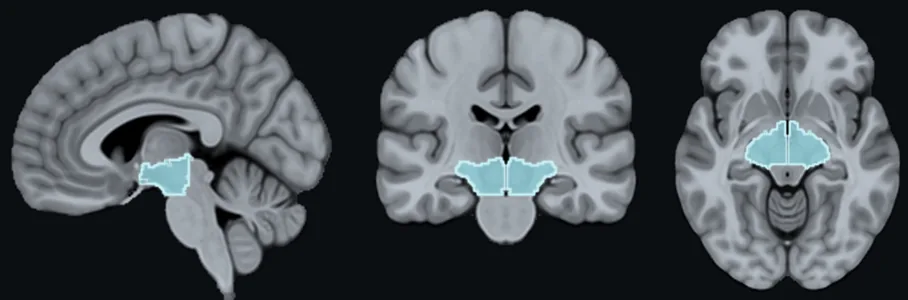
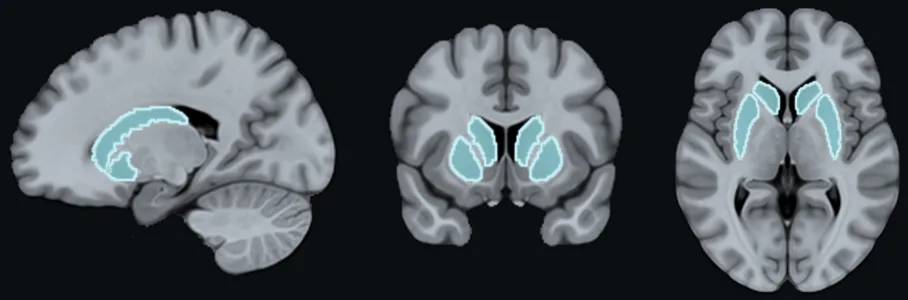
The dopamine-producing nerve cells that are lost lie in the substantia nigra of the midbrain4. The atlas does not outline the substantia nigra on its own; it lies within the highlighted region.
The substantia nigra sends dopamine to the striatum (putamen and caudate), which helps to start and scale movements4.
Signs and symptoms
Diagnosis rests on bradykinesia, meaning slowness and progressive reduction in the size and speed of movement, combined with rest tremor, rigidity (muscle stiffness), or both3,5. Symptoms usually begin on one side of the body. Many non-motor symptoms can appear years before movement problems, during what is called the prodromal phase3.
- Slowness of movement, smaller handwriting and reduced facial expression
- Tremor of a hand or limb when it is at rest
- Muscle stiffness and a stooped, shuffling walk; balance problems later in the condition
- Reduced sense of smell and constipation, often early3
- REM sleep behaviour disorder, in which people act out their dreams8
- Low mood, anxiety, apathy and, in some people, later problems with memory and thinking
- Dizziness on standing, bladder problems and fatigue
Causes and risk factors
In most people the cause is unknown and is thought to reflect an interaction between ageing, genetic susceptibility and environmental factors3,4. The risk rises with age, and the condition is more common in men than in women2.
- Older age: the average age of onset is in the early to mid-60s, and a small proportion of people develop symptoms before 502
- Male sex2
- Having a close relative with Parkinson’s disease or tremor3
- Inherited genetic variants3,6
- Constipation and being a non-smoker, each associated with at least a doubling of risk, although these associations do not by themselves show cause3
Genetics
In most populations about 3–5% of cases are monogenic, meaning caused by a change in a single gene3. Changes in more than 20 genes have been linked to the condition; many of these cause early-onset or unusual forms6.
Well-established genes include SNCA, which encodes the protein alpha-synuclein and was the first gene linked to the disease, LRRK2, and PRKN and PINK1, which are involved in removing damaged mitochondria (the cell’s energy-producing structures) and can cause early-onset forms2. Variants in GBA1, which affects lysosomes (the cell’s recycling compartments), are the most common genetic risk factor2.
Genome-wide association studies, which compare common DNA variants across very large groups of people, have identified 90 independent risk variants that together explain about 16–36% of the heritable risk7. Most of these studies involved people of European ancestry, so knowledge of genetic risk in other populations is still limited6.
What happens in the brain
The hallmark changes are the loss of dopamine-producing nerve cells in the substantia nigra, a small region of the midbrain, and clumps of misfolded alpha-synuclein protein inside nerve cells, known as Lewy bodies4. The substantia nigra sends dopamine to the striatum, a group of structures deep in the brain that helps to start and scale movements, so its loss produces the characteristic slowness and stiffness4.
Other cell types in the brain and in the autonomic nervous system, which controls automatic functions such as gut movement and blood pressure, are also affected, probably from early in the disease4. This helps to explain the wide range of non-motor symptoms.
Several interacting processes are thought to drive nerve cell damage, including the faulty handling and spread of alpha-synuclein, impaired mitochondrial function, oxidative stress (damage from reactive molecules), disturbed calcium balance and inflammation4.
How it is diagnosed
Diagnosis is clinical, based on a specialist’s history and examination using internationally agreed criteria3,5. In England, NICE guidance advises that people with suspected Parkinson’s disease are referred quickly and without treatment to a specialist9. Additional tests are generally reserved for people whose symptoms are atypical3.
- Neurological examination for bradykinesia, rest tremor and rigidity, and for features suggesting another diagnosis5
- Assessment of non-motor symptoms and response to dopamine-replacing medicine5
- Dopamine transporter imaging (a type of SPECT scan) or other imaging when the diagnosis is uncertain4
- MRI to look for other causes, such as stroke or other movement disorders4
- Alpha-synuclein seed amplification assays on cerebrospinal fluid, currently mainly a research test, which detected the disease with about 88% sensitivity and 96% specificity in a large study8
How scientists study it
Scans that measure dopamine nerve terminals and brain structure help with early and differential diagnosis and are used to track disease in trials4.
Seed amplification assays detect misfolded alpha-synuclein in cerebrospinal fluid, and can identify people in the prodromal phase, such as those with REM sleep behaviour disorder or loss of smell8.
Studies such as the Parkinson’s Progression Markers Initiative follow people with the disease, people at risk and healthy volunteers over many years to identify early markers and subtypes8.
Large genetic studies have identified risk genes and pointed to lysosomal pathways, and increasingly include participants of non-European ancestry6,7.
Stem cells can be turned into dopamine-producing nerve cells, both to study disease processes and as a source of cells for transplantation trials10,11.
Models based on toxins or on genes such as SNCA and LRRK2 are used to study mechanisms and to test candidate treatments, for example drugs first studied in mice12.
Current treatments
No current treatment has been shown to slow or stop the progression of Parkinson’s disease; treatment aims to control symptoms and maintain quality of life3.
Levodopa, which the brain converts to dopamine, is usually given in combination with carbidopa and is the most common first-line medicine1,3.
Dopamine agonists (which mimic dopamine), MAO-B inhibitors such as rasagiline (which slow dopamine breakdown) and amantadine are used alone or with levodopa, chosen according to individual needs and side effects2,9.
Surgically implanted electrodes deliver electrical pulses to specific brain areas; this is usually considered when medicines no longer control symptoms well or cause troublesome side effects such as involuntary movements2,4.
Problems such as low mood, sleep disturbance, constipation, low blood pressure and hallucinations are treated specifically9.
Physiotherapy, occupational therapy and speech and language therapy help with movement, balance, daily activities, speech and swallowing9.
Research frontiers
Biomarkers such as alpha-synuclein seed amplification may allow the disease to be identified before movement symptoms, so that future treatments could start earlier8.
Early-phase trials of dopamine cell precursors grown from embryonic or induced pluripotent stem cells have reported grafts that survive without serious safety concerns; larger trials are needed to test benefit10,11. This approach remains experimental.
In a phase 2 trial, lixisenatide, a diabetes medicine of the GLP-1 receptor agonist class, was associated with less worsening of motor disability over 12 months than placebo, though with frequent nausea; confirmation in larger trials is required12.
Antibodies directed at aggregated alpha-synuclein are being tested; one phase 2 trial of prasinezumab did not show a meaningful effect on its main outcome13.
Living with the condition and seeking help
Many people live for many years with Parkinson’s disease, and symptoms and their pace of change vary widely from person to person. Regular review by a specialist team allows treatment to be adjusted as needs change9.
Exercise, physiotherapy and staying socially active are widely encouraged. Information on driving, work, benefits and carers’ support is available from national Parkinson’s charities and health services.
Medicines should not be stopped suddenly without medical advice, because this can cause serious side effects2. People should seek prompt medical help for sudden worsening of symptoms, falls, new confusion or hallucinations, or difficulty swallowing.
References
- World Health Organization. Parkinson disease (fact sheet). 2023. Link
- National Institute of Neurological Disorders and Stroke, United States. Parkinson's disease. Link
- Bloem BR, Okun MS, Klein C. Parkinson's disease. Lancet. 2021;397:2284-2303. doi:10.1016/S0140-6736(21)00218-X · PubMed
- Poewe W, Seppi K, Tanner CM, et al. Parkinson disease. Nat Rev Dis Primers. 2017;3:17013. doi:10.1038/nrdp.2017.13 · PubMed
- Postuma RB, Berg D, Stern M, et al. MDS clinical diagnostic criteria for Parkinson's disease. Mov Disord. 2015;30:1591-1601. doi:10.1002/mds.26424 · PubMed
- Blauwendraat C, Nalls MA, Singleton AB. The genetic architecture of Parkinson's disease. Lancet Neurol. 2020;19:170-178. doi:10.1016/S1474-4422(19)30287-X · PubMed
- Nalls MA, Blauwendraat C, Vallerga CL, et al. Identification of novel risk loci, causal insights, and heritable risk for Parkinson's disease: a meta-analysis of genome-wide association studies. Lancet Neurol. 2019;18:1091-1102. doi:10.1016/S1474-4422(19)30320-5 · PubMed
- Siderowf A, Concha-Marambio L, Lafontant DE, et al. Assessment of heterogeneity among participants in the Parkinson's Progression Markers Initiative cohort using alpha-synuclein seed amplification: a cross-sectional study. Lancet Neurol. 2023;22:407-417. doi:10.1016/S1474-4422(23)00109-6 · PubMed
- National Institute for Health and Care Excellence (NICE), United Kingdom. Parkinson's disease in adults (NG71). 2017, last reviewed 2024. Link
- Tabar V, Sarva H, Lozano AM, et al. Phase I trial of hES cell-derived dopaminergic neurons for Parkinson's disease. Nature. 2025;641:978-983. doi:10.1038/s41586-025-08845-y · PubMed
- Sawamoto N, Doi D, Nakanishi E, et al. Phase I/II trial of iPS-cell-derived dopaminergic cells for Parkinson's disease. Nature. 2025;641:971-977. doi:10.1038/s41586-025-08700-0 · PubMed
- Meissner WG, Remy P, Giordana C, et al. Trial of lixisenatide in early Parkinson's disease. N Engl J Med. 2024;390:1176-1185. doi:10.1056/NEJMoa2312323 · PubMed
- Pagano G, Taylor KI, Anzures-Cabrera J, et al. Trial of prasinezumab in early-stage Parkinson's disease. N Engl J Med. 2022;387:421-432. doi:10.1056/NEJMoa2202867 · PubMed
Prepared 15 October 2026.
Last updated