Multiple sclerosis
Multiple sclerosis (MS) is a long-term condition in which the immune system attacks the brain, spinal cord and optic nerves, damaging myelin, the fatty layer that insulates nerve fibres. It is one of the most common causes of neurological disability in young adults, and although there is no cure, treatments can reduce relapses and slow disability2,4.
This information is for education. It is not medical advice and does not replace assessment by a qualified health professional. Anyone concerned about symptoms should consult a doctor; in an emergency, local emergency services should be contacted.
What it is
MS is an immune-mediated disease of the central nervous system, which consists of the brain, spinal cord and optic nerves. The immune system, which normally protects against infection, mistakenly attacks myelin and also damages nerve fibres and nerve cells themselves2,5.
Symptoms usually begin in young adults, typically between the ages of 20 and 402. The estimated number of people living with MS has risen in every world region since 20131.
Many disease-modifying treatments are now available, and the outlook for people diagnosed today is considerably better than in the past2,4.
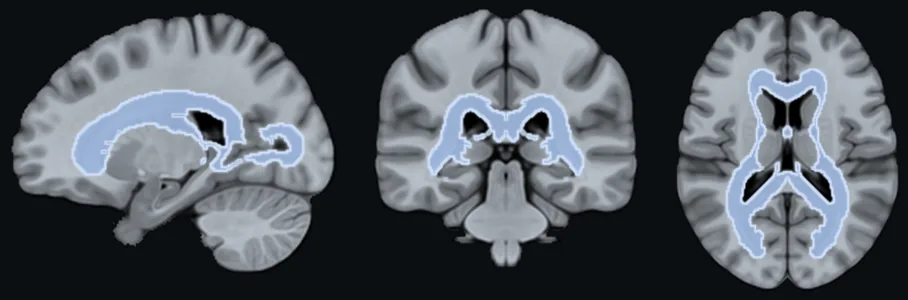
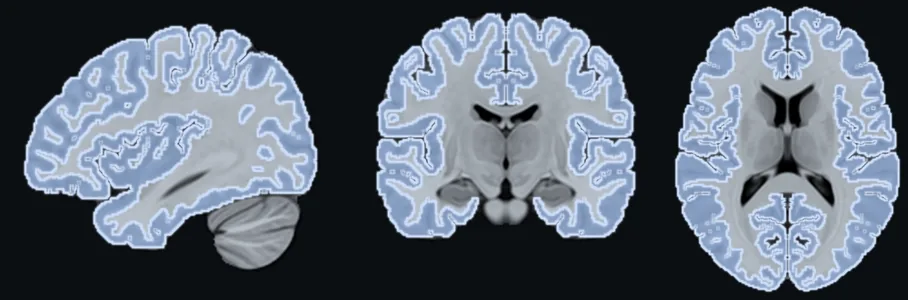
Lesions, where myelin has been stripped from nerve fibres, are typically seen on MRI in the white matter next to the ventricles and in other characteristic places5,6.
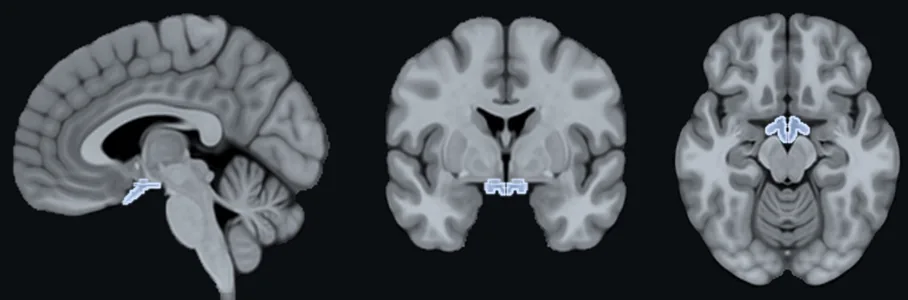
Inflammation of the optic nerve (optic neuritis) is a common first episode5, and the optic nerve now counts as a site of disease in the diagnostic criteria7. The highlighted region marks where the two optic nerves meet.
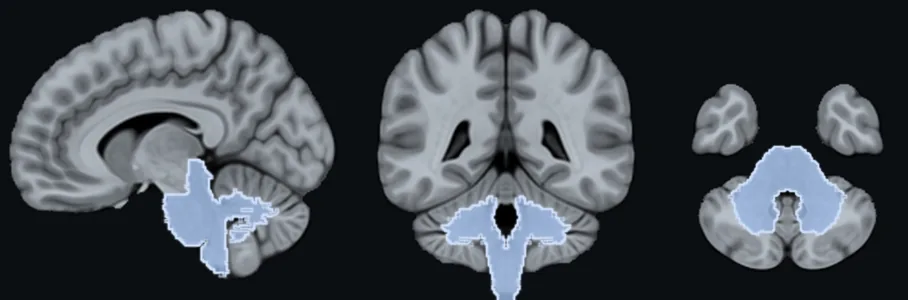
Lesions in the brainstem and cerebellum are among the characteristic sites used in diagnosis6. The spinal cord, also often affected, lies below this image5.
Damage is not limited to myelin: nerve cells are lost, including in the grey matter of the brain2,5.
Signs and symptoms
Symptoms depend on which parts of the nervous system are affected and differ widely between people3. Many people first experience an episode lasting days or weeks, such as inflammation of the optic nerve (optic neuritis) or numbness affecting part of the body5. Symptoms often worsen temporarily with heat, fever or infection2.
- Fatigue, physical or mental, which is very common2,3
- Blurred vision, eye pain or double vision2,3
- Numbness or tingling in parts of the body3
- Muscle weakness, stiffness and spasms, and difficulty walking2,3
- Problems with balance, coordination and dizziness2,3
- Bladder and bowel problems2,3
- Changes in memory, concentration and mood, including depression2
Causes and risk factors
The cause of MS is not fully understood. It is thought to arise from an interaction between genetic susceptibility and environmental exposures4. Strong evidence now implicates infection with Epstein-Barr virus (EBV), a very common virus that causes glandular fever, although most people infected with EBV never develop MS2,8.
- Previous EBV infection: in a study of more than 10 million US military personnel, MS risk rose about 32-fold after infection with EBV but not after other viruses8
- Female sex1,3
- Having a parent, brother or sister with MS3
- Smoking, which is linked to a higher risk and a more aggressive course2,3
- Low sunlight exposure and low vitamin D levels, and living further from the equator2
- Genetic variants affecting the immune system9
Genetics
MS is not inherited in a simple way, and no single gene causes it. Instead, many common genetic variants each add a small amount to a person’s risk.
A genetic study of more than 47,000 people with MS and 68,000 controls mapped 233 susceptibility variants, including 32 within the major histocompatibility complex, a gene region that controls how the immune system recognises foreign material9.
The genes implicated point to many parts of the immune system and to microglia, the brain’s resident immune cells. This supports the view that MS is triggered by changes in immune responses outside the brain that are then directed at the central nervous system9.
What happens in the brain
In MS, immune cells cross into the central nervous system and cause areas of inflammation that strip myelin from nerve fibres. These areas, called lesions or plaques, slow or block electrical signals along the nerves2,5.
Damage is not limited to myelin. Nerve fibres are cut and nerve cells are lost, including in the grey matter of the brain, and this neurodegeneration is thought to underlie much of the long-term disability2,5.
Disability can accumulate gradually even without relapses. This is partly attributed to chronic, smouldering inflammation within the central nervous system involving microglia and other immune cells, which current treatments only partly address11.
How it is diagnosed
There is no single test for MS3. A neurologist combines the history and examination with MRI and laboratory findings, using internationally agreed criteria known as the McDonald criteria5,6. These were revised in 2024 to allow earlier diagnosis while maintaining accuracy, for example by counting the optic nerve as a site of disease7.
- Neurological examination of movement, coordination, vision, balance and reflexes3
- MRI of the brain and spinal cord to show lesions in different places and at different times5,6
- Lumbar puncture to examine cerebrospinal fluid for oligoclonal bands, antibodies made within the nervous system5,6
- Newer supporting markers such as the central vein sign on MRI and kappa free light chains in cerebrospinal fluid7
- Optical coherence tomography (a scan of the retina) or visual evoked potentials to detect optic nerve involvement2,7
- Blood tests to exclude other conditions that can look like MS3
How scientists study it
MRI shows new and active lesions and brain volume loss; lesion volume and brain volume loss are used as outcomes in clinical trials10.
Long-term studies of very large populations, such as US military personnel with stored blood samples, have linked EBV infection to later MS8.
Neurofilament light chain, a protein released when nerve fibres are damaged, can be measured in blood and rises after EBV infection in people who later develop MS8.
International genome-wide studies have mapped hundreds of risk variants and the immune cells they act in9.
Visual evoked potentials and retinal scans measure damage and repair in the optic nerve, and have been used to test remyelinating drugs7,12.
Laboratory models of demyelination are used to find drugs that help precursor cells mature into myelin-making cells, as was shown for clemastine before human testing12.
Current treatments
There is no cure for MS, but treatments can reduce the number and severity of relapses and delay long-term progression2.
Several classes are available for relapsing MS, including interferons, glatiramer acetate, teriflunomide, sphingosine 1-phosphate receptor modulators such as fingolimod, fumarates, cladribine and monoclonal antibodies; they reduce annual relapse rates by about 29–68% compared with placebo or older treatments5.
Ocrelizumab, an antibody that depletes B cells (a type of immune cell), modestly reduced disability progression in primary progressive MS and is approved for this form5,10.
Short courses of corticosteroids, such as methylprednisolone, speed recovery from relapses but do not change the long-term outcome2.
Medicines and other treatments are used for muscle spasms, pain, bladder and bowel problems, fatigue and mood, and dalfampridine can improve walking speed in some people2,3.
Physiotherapy, occupational therapy, regular physical activity, cognitive rehabilitation and psychological therapies help people maintain function and wellbeing2,3.
Autologous haematopoietic stem cell transplantation, which resets the immune system using a person’s own stem cells, is an option for some people with highly active relapsing MS that has not responded to other treatments13.
Research frontiers
Bruton’s tyrosine kinase inhibitors, oral drugs that enter the brain and act on microglia and B cells, are being tested; in one phase 3 trial, tolebrutinib reduced disability progression in non-relapsing secondary progressive MS but caused liver enzyme rises in some participants11.
Remyelinating drugs aim to restore lost myelin. In a small trial, clemastine fumarate, an older antihistamine, modestly improved nerve conduction in the visual pathway; this approach remains experimental12.
The strong link with Epstein-Barr virus has opened research into whether preventing or controlling this infection could reduce MS risk; this is not yet established8.
Newer imaging and fluid markers incorporated into the 2024 criteria aim to diagnose MS earlier and reduce misdiagnosis7.
Experts continue to debate where transplantation fits in treatment and whether it helps in progressive MS13.
Living with the condition and seeking help
MS affects people very differently; some have mild symptoms with little disability, while others accumulate disability over time2. Regular follow-up with an MS team allows treatment to be adjusted to individual needs.
Staying physically active, not smoking, and managing other health conditions can support wellbeing. Support may include fatigue management, mobility aids, home adaptations and psychological therapy3.
Anyone who develops sudden weakness or numbness in one arm, sudden loss of vision or sudden problems with balance should seek emergency care, as these can also be signs of a stroke3. In India, the national emergency number is 112 and the ambulance number is 10815,16.
References
- Walton C, King R, Rechtman L, et al. Rising prevalence of multiple sclerosis worldwide: insights from the Atlas of MS, third edition. Mult Scler. 2020;26:1816-1821. doi:10.1177/1352458520970841 · PubMed
- National Institute of Neurological Disorders and Stroke, United States. Multiple sclerosis (MS). Link
- NHS (United Kingdom). Multiple sclerosis. Link
- Jakimovski D, Bittner S, Zivadinov R, et al. Multiple sclerosis. Lancet. 2024;403:183-202. doi:10.1016/S0140-6736(23)01473-3 · PubMed
- McGinley MP, Goldschmidt CH, Rae-Grant AD. Diagnosis and treatment of multiple sclerosis: a review. JAMA. 2021;325:765-779. doi:10.1001/jama.2020.26858 · PubMed
- Thompson AJ, Banwell BL, Barkhof F, et al. Diagnosis of multiple sclerosis: 2017 revisions of the McDonald criteria. Lancet Neurol. 2018;17:162-173. doi:10.1016/S1474-4422(17)30470-2 · PubMed
- Montalban X, Lebrun-Frénay C, Oh J, et al. Diagnosis of multiple sclerosis: 2024 revisions of the McDonald criteria. Lancet Neurol. 2025;24:850-865. doi:10.1016/S1474-4422(25)00270-4 · PubMed
- Bjornevik K, Cortese M, Healy BC, et al. Longitudinal analysis reveals high prevalence of Epstein-Barr virus associated with multiple sclerosis. Science. 2022;375:296-301. doi:10.1126/science.abj8222 · PubMed
- International Multiple Sclerosis Genetics Consortium. Multiple sclerosis genomic map implicates peripheral immune cells and microglia in susceptibility. Science. 2019;365:eaav7188. doi:10.1126/science.aav7188 · PubMed
- Montalban X, Hauser SL, Kappos L, et al. Ocrelizumab versus placebo in primary progressive multiple sclerosis. N Engl J Med. 2017;376:209-220. doi:10.1056/NEJMoa1606468 · PubMed
- Fox RJ, Bar-Or A, Traboulsee A, et al. Tolebrutinib in nonrelapsing secondary progressive multiple sclerosis. N Engl J Med. 2025;392:1883-1892. doi:10.1056/NEJMoa2415988 · PubMed
- Green AJ, Gelfand JM, Cree BA, et al. Clemastine fumarate as a remyelinating therapy for multiple sclerosis (ReBUILD): a randomised, controlled, double-blind, crossover trial. Lancet. 2017;390:2481-2489. doi:10.1016/S0140-6736(17)32346-2 · PubMed
- Muraro PA, Mariottini A, Greco R, et al. Autologous haematopoietic stem cell transplantation for treatment of multiple sclerosis and neuromyelitis optica spectrum disorder - recommendations from ECTRIMS and the EBMT. Nat Rev Neurol. 2025;21:140-158. doi:10.1038/s41582-024-01050-x · PubMed
- Scheinok TJ, D'Haeseleer M, Nagels G, De Bundel D, Van Schependom J. Neuronal activity and NIBS in developmental myelination and remyelination - current state of knowledge. Prog Neurobiol. 2023;226:102459. doi:10.1016/j.pneurobio.2023.102459 · PubMed
- Press Information Bureau, Government of India (Ministry of Women and Child Development). Panic button becomes available to women with launch of ERSS and pan-India emergency number 112. 19 February 2019. Link
- National Health Mission, Ministry of Health and Family Welfare, Government of India. ERS/Patient Transport Service: National Ambulance Service (Dial 108/102). Accessed October 2026. Link
Prepared 15 October 2026.
Last updated