Depression
Depression is a common mental health condition in which low mood or loss of interest and pleasure persists for weeks or longer and affects how a person feels, thinks and manages daily life1,2. It is a real and treatable illness, not a sign of weakness, and with the right treatment and support most people recover12.
This information is for education. It is not medical advice and does not replace assessment by a qualified health professional. Anyone concerned about symptoms should consult a doctor; in an emergency, local emergency services should be contacted.
What it is
Depression, also called major depressive disorder or clinical depression, involves a persistently low mood or loss of interest or pleasure in activities, lasting most of the day, nearly every day, for at least two weeks1,2. It differs from ordinary sadness and short-lived reactions to everyday difficulties1.
Depression can affect anyone, and it can disrupt sleep, appetite, concentration, work, study and relationships1,2. It is about 1.5 times more common among women than among men1.
Depression can lead to suicide. In 2021 an estimated 727 000 people died by suicide worldwide, and in high-income countries only about a third of people with depression receive mental health treatment1.
Depression may occur as a single episode or recur. Related forms include persistent depressive disorder (dysthymia), in which milder symptoms last at least two years, perinatal depression during pregnancy or after childbirth, seasonal affective disorder, and depression with psychosis1,2.
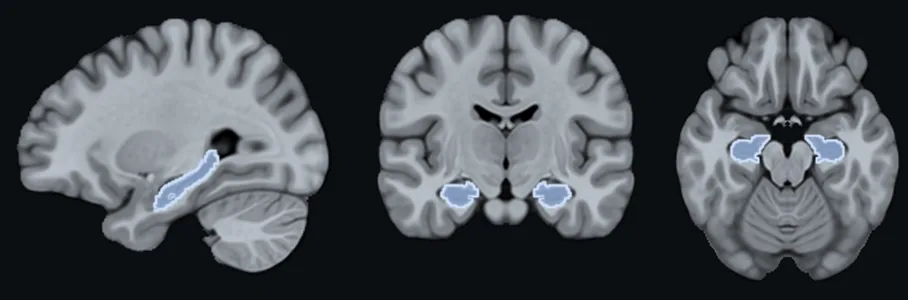
A pooled analysis of nearly 9 000 people found a slightly smaller hippocampus, a region involved in memory and stress responses, mainly in people with recurrent depression7.
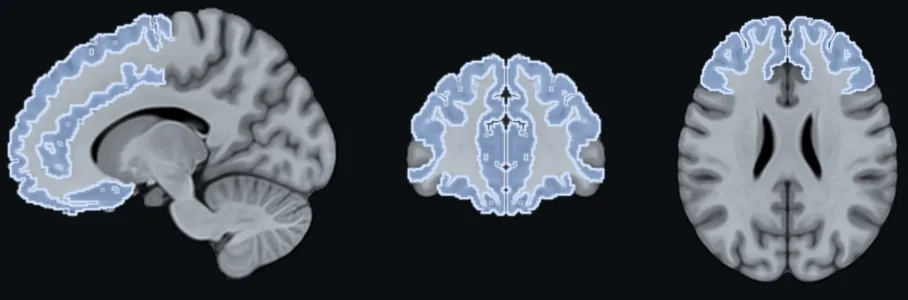
Networks for emotion and cognitive control, including the prefrontal cortex, function differently on average in depression4; genetic findings also point to the prefrontal cortex6.
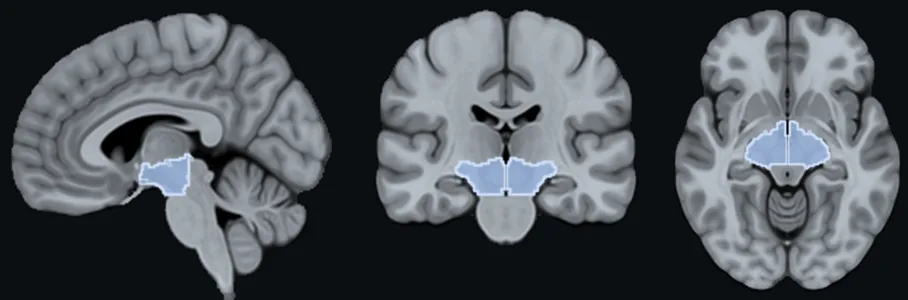
The hypothalamus starts the hormonal stress response of the hypothalamic–pituitary–adrenal axis, which is often disturbed in depression4. The atlas does not outline the hypothalamus on its own; it lies within the highlighted region.
Signs and symptoms
Not everyone has every symptom, and depression can look different at different ages. Children and teenagers may be irritable rather than sad, while older adults may describe a lack of emotion rather than low mood2.
- Persistent sad, anxious or ‘empty’ mood, or irritability1,2
- Loss of interest or pleasure in activities once enjoyed, known as anhedonia2,6
- Feelings of guilt, worthlessness or hopelessness about the future1,2
- Tiredness, lack of energy, or feeling slowed down or restless2
- Difficulty concentrating, remembering or making decisions1,2
- Sleeping badly, waking early or oversleeping, and changes in appetite or weight1,2
- Aches, pains or digestive problems without a clear physical cause2
- Thoughts of death or suicide1,2
Causes and risk factors
Depression results from a complex interaction of social, psychological and biological factors, and no single cause explains it1,4. Sometimes there is a clear trigger, but depression can also develop for no obvious reason12.
Depression and physical illness often affect each other. Depression is common alongside conditions such as diabetes, cancer, heart disease and chronic pain, and some medicines can contribute to symptoms2.
- Adverse life events, such as bereavement, unemployment or trauma1,12
- Sexual, physical or emotional abuse in childhood4
- A family history of depression5,12
- Female sex: depression is about 1.5 to 2 times more common in women, depending on the estimate1,4
- Hormonal and physical changes around pregnancy, childbirth, the menstrual cycle and menopause2
- Long-term physical illness2
Genetics
Depression runs in families. In a meta-analysis of family studies, close relatives of people with major depression had nearly three times the odds of developing it themselves5. Twin studies estimate its heritability at about 37%, with individual experiences and environment accounting for much of the remaining variation5.
No single gene causes depression. A meta-analysis of genome-wide association studies (GWAS) including more than 800 000 people identified 102 independent genetic variants, each with a very small effect, including genes involved in synapses, the junctions where nerve cells communicate6.
Earlier ideas that common variants in single genes, such as the serotonin transporter gene, explain depression have not been supported by the largest studies9.
What happens in the brain
No single established mechanism explains all aspects of depression4. On average, people with depression show functional changes in brain networks involved in emotion and in cognitive control, the ability to direct thinking and attention4.
Brain imaging has found slightly smaller volume of the hippocampus, a region involved in memory and stress responses, in people with depression. In a pooled analysis of nearly 9 000 people, this difference was small and was driven mainly by people with recurrent depression7.
Depression is also linked to disturbances in the body’s stress-response systems, including the hypothalamic-pituitary-adrenal (HPA) axis, which controls the stress hormone cortisol, and the immune system4.
Depression has often been described as a ‘chemical imbalance’ of serotonin, a chemical messenger. A 2022 umbrella review found no consistent evidence that depression is caused by low serotonin; this does not mean that antidepressants are ineffective, and how they work is still debated8,9.
How it is diagnosed
Depression is diagnosed by a health professional, such as a family doctor, psychologist or psychiatrist, through a careful conversation about symptoms and their effect on daily life2. A diagnosis requires symptoms most of the day, nearly every day, for at least two weeks, including low mood or loss of interest or pleasure2. Varied presentations and an unpredictable course can make depression difficult to recognise3.
- Discussion of when symptoms began, how long they have lasted and how they affect everyday activities2
- Rating scales such as the PHQ-9 questionnaire, which NICE in the United Kingdom uses to distinguish less severe from more severe depression11
- Physical examination and laboratory tests to rule out other causes, such as thyroid disorders, viral infections or medicine side effects2
- Assessment of any thoughts of suicide, and of the support available to the person11
- Distinguishing depression from bipolar disorder, in which depressive episodes alternate with periods of elevated mood or mania1,2
How scientists study it
Very large genetic studies, combining data from hundreds of thousands of people, identify common variants linked to depression and the biological pathways they point to6.
Comparing identical and non-identical twins and their relatives allows researchers to estimate how much of the risk is genetic and how much environmental5.
International consortia such as ENIGMA pool brain scans from thousands of people to detect small but reliable differences in brain structure7.
Blood and other measures of cortisol and inflammation are studied to understand the biology of depression and why people respond differently to treatment4.
Network meta-analyses combine hundreds of clinical trials to compare the effectiveness and acceptability of different antidepressants8.
Reviews that summarise many systematic reviews test long-standing ideas, such as the serotonin hypothesis, against the overall evidence9.
Current treatments
Talking therapies, including cognitive behavioural therapy (CBT), behavioural activation, interpersonal therapy and problem-solving therapy, are effective and are often the first treatments offered1,2.
Indian clinical practice guidelines note that most depression seen in clinics is mild to moderate and can be managed in outpatient care17. For less severe depression, NICE in the United Kingdom advises considering the least intrusive option first, such as guided self-help, with group therapies and group exercise among the other choices11.
Medicines such as selective serotonin reuptake inhibitors (SSRIs), for example fluoxetine, are commonly used, particularly for moderate or severe depression1,2. A large network meta-analysis found that all 21 antidepressants studied were more effective than placebo in adults8. They usually take 4-8 weeks to work, and young people under 25 need close monitoring for increased suicidal thoughts early in treatment2.
When at least two antidepressants have not helped, options include combining an antidepressant with another medicine, such as lithium or an antipsychotic, or esketamine nasal spray, which is approved in the United States for this purpose2,11.
Research frontiers
In a phase 2 trial in treatment-resistant depression, a single higher dose of psilocybin given with psychological support reduced symptoms more than a very low dose at three weeks, but benefits were not clearly sustained at 12 weeks and adverse effects were common10.
Esketamine can relieve symptoms within hours rather than weeks, prompting research into faster-acting treatments with new mechanisms2.
Researchers are investigating stress hormones, inflammation and brain-circuit changes as alternative or additional explanations for depression4,9.
Genetic findings implicate synaptic structure, neurotransmission and the prefrontal cortex, offering possible new treatment targets6.
Large pooled imaging studies aim to find brain measures that are robust enough to help understand subtypes and the course of depression7.
Living with the condition and seeking help
Low mood, loss of interest or other symptoms that last for more than a couple of weeks or affect daily life should be discussed with a family doctor or another health professional. Many people wait a long time before seeking help, but the sooner treatment starts, the sooner recovery can begin12.
Finding the right treatment can take time and may involve trying more than one approach2. Regular exercise, reducing alcohol, and reading a self-help book or joining a support group can also help12.
Anyone who is thinking about suicide, has harmed themselves or feels unable to stay safe should get help immediately by contacting local emergency services or a crisis line, or by going to the nearest emergency department. A person who is worried about someone else should encourage them to seek help and should not leave them alone if they are in immediate danger. In India, emergency help is available on 11218, and Tele-MANAS, the national tele-mental health service, offers free support at all hours on 1441619.
References
- World Health Organization. Depressive disorder (depression) (fact sheet). 11 September 2026. Link
- National Institute of Mental Health, United States. Depression (NIH publication). Revised 2024. Link
- Malhi GS, Mann JJ. Depression. Lancet. 2018;392:2299-2312. doi:10.1016/S0140-6736(18)31948-2 · PubMed
- Otte C, Gold SM, Penninx BW, et al. Major depressive disorder. Nat Rev Dis Primers. 2016;2:16065. doi:10.1038/nrdp.2016.65 · PubMed
- Sullivan PF, Neale MC, Kendler KS. Genetic epidemiology of major depression: review and meta-analysis. Am J Psychiatry. 2000;157:1552-1562. doi:10.1176/appi.ajp.157.10.1552 · PubMed
- Howard DM, Adams MJ, Clarke TK, et al. Genome-wide meta-analysis of depression identifies 102 independent variants and highlights the importance of the prefrontal brain regions. Nat Neurosci. 2019;22:343-352. doi:10.1038/s41593-018-0326-7 · PubMed
- Schmaal L, Veltman DJ, van Erp TGM, et al. Subcortical brain alterations in major depressive disorder: findings from the ENIGMA Major Depressive Disorder working group. Mol Psychiatry. 2016;21:806-812. doi:10.1038/mp.2015.69 · PubMed
- Cipriani A, Furukawa TA, Salanti G, et al. Comparative efficacy and acceptability of 21 antidepressant drugs for the acute treatment of adults with major depressive disorder: a systematic review and network meta-analysis. Lancet. 2018;391:1357-1366. doi:10.1016/S0140-6736(17)32802-7 · PubMed
- Moncrieff J, Cooper RE, Stockmann T, et al. The serotonin theory of depression: a systematic umbrella review of the evidence. Mol Psychiatry. 2023;28:3243-3256. doi:10.1038/s41380-022-01661-0 · PubMed
- Goodwin GM, Aaronson ST, Alvarez O, et al. Single-dose psilocybin for a treatment-resistant episode of major depression. N Engl J Med. 2022;387:1637-1648. doi:10.1056/NEJMoa2206443 · PubMed
- National Institute for Health and Care Excellence (NICE), United Kingdom. Depression in adults: treatment and management (NG222). Recommendations. 2022. Link
- NHS (United Kingdom). Overview: Depression in adults. Page last reviewed 5 July 2023. Link
- Swaab DF, Bao AM, Lucassen PJ. The stress system in the human brain in depression and neurodegeneration. Ageing Res Rev. 2005;4:141-194. doi:10.1016/j.arr.2005.03.003 · PubMed
- Holsboer F. The corticosteroid receptor hypothesis of depression. Neuropsychopharmacology. 2000;23:477-501. doi:10.1016/S0893-133X(00)00159-7 · PubMed
- Coleman JA, Green EM, Gouaux E. X-ray structures and mechanism of the human serotonin transporter. Nature. 2016;532:334-339. doi:10.1038/nature17629 · PubMed
- Harmer CJ, Duman RS, Cowen PJ. How do antidepressants work? New perspectives for refining future treatment approaches. Lancet Psychiatry. 2017;4:409-418. doi:10.1016/S2215-0366(17)30015-9 · PubMed
- Gautam S, Jain A, Gautam M, Vahia VN, Grover S. Clinical practice guidelines for the management of depression. Indian J Psychiatry. 2017;59(Suppl 1):S34-S50. doi:10.4103/0019-5545.196973 · PubMed
- Press Information Bureau, Government of India (Ministry of Women and Child Development). Panic button becomes available to women with launch of ERSS and pan-India emergency number 112. 19 February 2019. Link
- Press Information Bureau, Government of India (Ministry of Health and Family Welfare). Update on National Tele Mental Health Programme (NTMHP). 4 April 2025. Link
Prepared 15 October 2026.
Last updated