Cerebral palsy
Cerebral palsy is a group of lifelong conditions affecting movement and posture, caused by a non-progressive injury to, or difference in, the developing brain before, during or soon after birth. It is the most common cause of physical disability that starts in childhood, and while there is no cure, therapy and treatment can greatly improve function and participation1,2.
This information is for education. It is not medical advice and does not replace assessment by a qualified health professional. Anyone concerned about symptoms should consult a doctor; in an emergency, local emergency services should be contacted.
What it is
Cerebral palsy describes a group of permanent disorders of movement and posture that limit activity and are attributed to non-progressive disturbances in the developing fetal or infant brain. These movement problems are often accompanied by difficulties with sensation, perception, thinking, communication and behaviour, by epilepsy, and by secondary musculoskeletal problems2.
It is a clinical description rather than a single disease: the type of movement disorder, the parts of the body affected and the degree of ability vary greatly1. The brain injury itself does not get worse, but its effects on muscles and joints can change as a child grows1,4.
In high-income countries, the birth prevalence of cerebral palsy caused before or around birth has fallen in recent decades3.
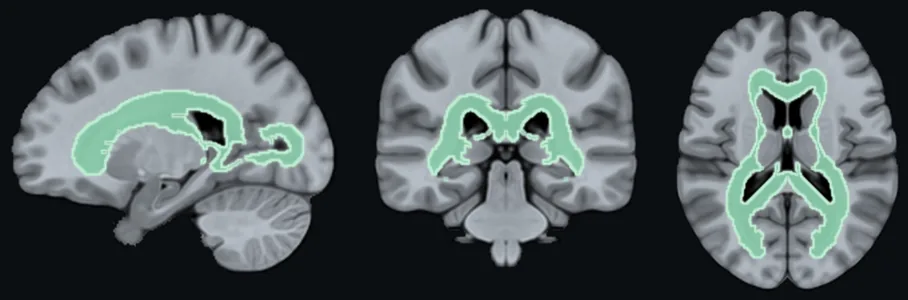
Damage to the white matter around the fluid-filled ventricles is typical in babies born preterm14,15. Fibres carrying movement signals from the cortex pass through this region.
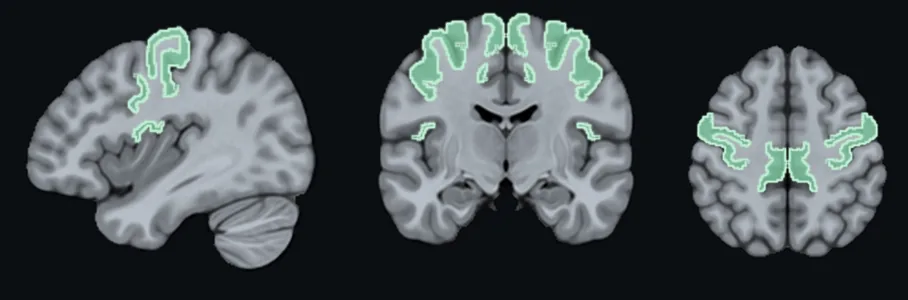
The motor cortex and its pathways control voluntary movement; injury to them disrupts muscle tone, leading to spasticity1,2,14.
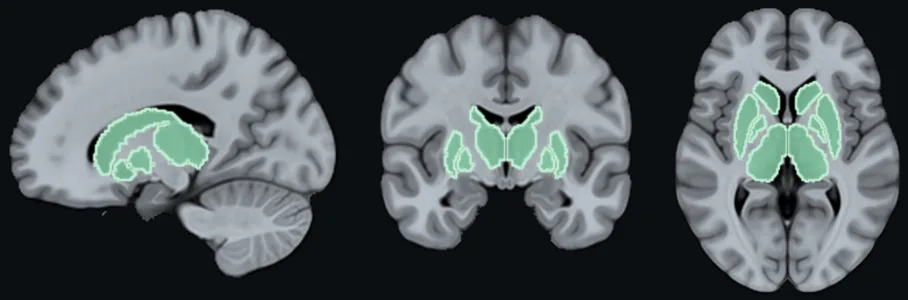
Oxygen deprivation around birth at term can damage deep grey matter such as the basal ganglia and thalamus14,16. Injury to these structures is typically associated with dyskinetic forms17.
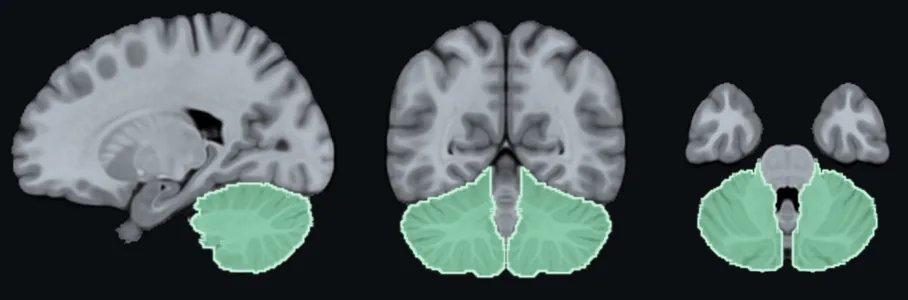
The cerebellum coordinates movement. Ataxic forms are thought to involve it, although brain scans of children with ataxic cerebral palsy are often normal18.
Signs and symptoms
Signs usually emerge and evolve during the first two years of life5. Babies may be slow to roll over, sit, crawl or walk, may feel unusually floppy or stiff, or may favour one side of the body4. Cerebral palsy is classified by the main type of movement problem: spastic (stiff muscles), which is the most common, dyskinetic (involuntary writhing or jerky movements), ataxic (poor balance and coordination), or mixed4.
- Muscle stiffness and exaggerated reflexes (spasticity), or floppy muscle tone4
- Weakness affecting one side of the body, mainly the legs, or all four limbs4
- Unusual walking patterns, such as walking on tiptoe or with a crouched or scissored gait4
- Delayed motor milestones and difficulty with fine hand movements4
- Associated conditions such as epilepsy, intellectual or learning difficulties, and problems with hearing, vision, speech and swallowing1,4
- Later problems such as hip displacement, scoliosis (curvature of the spine) and pain1,4
Causes and risk factors
Most cerebral palsy is congenital, meaning the brain injury or difference occurs before or around birth; a smaller number of cases are acquired after birth, for example through brain infection, stroke or head injury4. In many cases a single cause cannot be identified4.
- Premature birth and low birthweight4
- Twin, triplet and other multiple births4
- Infections during pregnancy, such as cytomegalovirus, rubella, toxoplasmosis and Zika virus4
- Reduced oxygen supply to the baby’s brain around birth (hypoxic-ischaemic injury)10
- Stroke in the baby before or soon after birth4
- Genetic variants, increasingly recognised in children without traditional risk factors10,11
Genetics
As many as one-third of children with cerebral palsy have none of the traditional risk factors such as prematurity or oxygen deprivation, and in many of them a genetic basis is suspected10.
Whole-exome sequencing, which reads the protein-coding parts of all genes, of 250 children and their parents found an excess of new (de novo) damaging mutations. Two genes, TUBA1A and CTNNB1, reached genome-wide significance, and the authors estimated that about 14% of cases could be attributed to damaging de novo or recessive variants11.
Many of the genes involved overlap with those linked to other neurodevelopmental disorders and affect how nerve cells form connections11. Genetic findings can matter for families, because they may change advice about recurrence and care. The field is still developing, and most cerebral palsy is not inherited.
What happens in the brain
Cerebral palsy results from injury to, or abnormal development of, the brain areas and pathways that control movement, while the brain is still developing1,2. Common patterns include damage to the white matter around the fluid-filled ventricles, typical in babies born preterm, damage to deep grey matter such as the basal ganglia and thalamus after oxygen deprivation around birth at term, and injury from stroke14,15,16.
Damage to the motor pathways, which run from the motor cortex past the ventricles to the spinal cord, disrupts the signals that normally regulate muscle tone, leading to spasticity14. Injury to the basal ganglia and thalamus, deep structures that help control movement, is typically associated with dyskinetic forms17. Ataxic forms, with poor balance and coordination, are thought to involve the cerebellum, which coordinates movement, although brain scans are often normal18.
Over time, abnormal muscle tone and weakness can cause muscles to shorten (contractures) and bones and joints to develop abnormally, for example hip displacement and scoliosis1,4,14.
How it is diagnosed
Diagnosis was historically made between 12 and 24 months of age, but with standardised tools it can now be made accurately before 6 months’ corrected age (age adjusted for prematurity) in high-risk infants5. Early diagnosis allows early intervention while the brain is most adaptable5.
- Detailed history of pregnancy, birth and development, and regular monitoring of motor skills, tone, posture, hearing and vision4,5
- MRI of the brain, which detects risk with about 86–89% sensitivity5
- The Prechtl General Movements Assessment, a video-based assessment of spontaneous movements in young infants, with about 98% sensitivity before 5 months5
- The Hammersmith Infant Neurological Examination, a standardised clinical examination5
- The Gross Motor Function Classification System, which grades mobility into five levels to describe severity6
- Genetic testing in selected children, particularly when there are no clear risk factors10,11
How scientists study it
Cerebral palsy registers and surveillance systems in many countries track prevalence and trends, showing the effect of changes in pregnancy and newborn care3.
MRI in infancy identifies patterns of brain injury and is used to predict which babies are at high risk1,5.
Tools such as the General Movements Assessment and Gross Motor Function Measure are used to detect cerebral palsy early and to measure change in trials5,13.
Sequencing of children and parents identifies new genetic causes and pathways affecting early nerve cell connectivity11.
Fruit-fly and other models are used to test whether candidate genes affect movement control11.
Current treatments
There is no cure for cerebral palsy; management aims to maximise function and participation and to prevent complications such as hip dislocation and scoliosis1,4.
Antenatal corticosteroids, magnesium sulphate for women at risk of very early birth, caffeine for preterm babies and cooling (therapeutic hypothermia) for babies with oxygen-deprivation brain injury reduce the risk of cerebral palsy7,8,9.
Goal-directed and task-specific training, constraint-induced movement therapy, bimanual training and fitness and strength training are supported by evidence7.
Muscle relaxants such as diazepam and baclofen, and injections of botulinum toxin into overactive muscles, can reduce spasticity; botulinum toxin works best combined with therapy and splinting4,7.
Research frontiers
Diagnosing cerebral palsy in the first months of life is being combined with very early, intensive therapy designed to make the most of the infant brain’s adaptability5.
Wider use of sequencing may identify genetic causes, inform family counselling and, in future, suggest targeted treatments10,11.
A pooled analysis of 11 studies found that cord blood infusions produced small gains in gross motor function, with larger effects at higher doses and in younger children with milder cerebral palsy; this remains experimental13.
Researchers are seeking further treatments that, like magnesium sulphate and cooling, protect the newborn brain from injury1,7.
Most research and services focus on children, and there is growing attention to the needs of adults with cerebral palsy1.
Living with the condition and seeking help
Many people with cerebral palsy lead full, independent lives, while others need substantial support. Care is usually coordinated by a multidisciplinary team, and in the United Kingdom NICE guidance emphasises giving families clear information and support12.
Parents who are concerned about a baby’s movements, muscle tone or delayed milestones should speak to a family doctor, paediatrician or child health worker, as early assessment allows early intervention5. In India, the Rashtriya Bal Swasthya Karyakram screens children for motor and other developmental delays and refers them to District Early Intervention Centres19.
Urgent medical help should be sought for a prolonged seizure, breathing or swallowing difficulty, or a sudden change in ability or alertness. In India, the national emergency number is 112 and the ambulance number is 10820,21.
References
- Graham HK, Rosenbaum P, Paneth N, et al. Cerebral palsy. Nat Rev Dis Primers. 2016;2:15082. doi:10.1038/nrdp.2015.82 · PubMed
- Rosenbaum P, Paneth N, Leviton A, et al. A report: the definition and classification of cerebral palsy April 2006. Dev Med Child Neurol Suppl. 2007;109:8-14. doi:10.1111/j.1469-8749.2007.tb12610.x · PubMed
- McIntyre S, Goldsmith S, Webb A, et al. Global prevalence of cerebral palsy: a systematic analysis. Dev Med Child Neurol. 2022;64:1494-1506. doi:10.1111/dmcn.15346 · PubMed
- National Institute of Neurological Disorders and Stroke, United States. Cerebral palsy. Link
- Novak I, Morgan C, Adde L, et al. Early, accurate diagnosis and early intervention in cerebral palsy: advances in diagnosis and treatment. JAMA Pediatr. 2017;171:897-907. doi:10.1001/jamapediatrics.2017.1689 · PubMed
- Palisano R, Rosenbaum P, Walter S, et al. Development and reliability of a system to classify gross motor function in children with cerebral palsy. Dev Med Child Neurol. 1997;39:214-223. doi:10.1111/j.1469-8749.1997.tb07414.x · PubMed
- Novak I, Morgan C, Fahey M, et al. State of the evidence traffic lights 2019: systematic review of interventions for preventing and treating children with cerebral palsy. Curr Neurol Neurosci Rep. 2020;20:3. doi:10.1007/s11910-020-1022-z · PubMed
- Doyle LW, Crowther CA, Middleton P, et al. Magnesium sulphate for women at risk of preterm birth for neuroprotection of the fetus. Cochrane Database Syst Rev. 2009;(1):CD004661. doi:10.1002/14651858.CD004661.pub3 · PubMed
- Jacobs SE, Berg M, Hunt R, et al. Cooling for newborns with hypoxic ischaemic encephalopathy. Cochrane Database Syst Rev. 2013;(1):CD003311. doi:10.1002/14651858.CD003311.pub3 · PubMed
- Fahey MC, Maclennan AH, Kretzschmar D, et al. The genetic basis of cerebral palsy. Dev Med Child Neurol. 2017;59:462-469. doi:10.1111/dmcn.13363 · PubMed
- Jin SC, Lewis SA, Bakhtiari S, et al. Mutations disrupting neuritogenesis genes confer risk for cerebral palsy. Nat Genet. 2020;52:1046-1056. doi:10.1038/s41588-020-0695-1 · PubMed
- National Institute for Health and Care Excellence (NICE), United Kingdom. Cerebral palsy in under 25s: assessment and management (NG62). 2017, last reviewed 2024. Link
- Finch-Edmondson M, Paton MCB, Webb A, et al. Cord blood treatment for children with cerebral palsy: individual participant data meta-analysis. Pediatrics. 2025;155:e2024068999. doi:10.1542/peds.2024-068999 · PubMed
- Patel DR, Neelakantan M, Pandher K, Merrick J. Cerebral palsy in children: a clinical overview. Transl Pediatr. 2020;9(Suppl 1):S125-S135. doi:10.21037/tp.2020.01.01 · PubMed
- Krägeloh-Mann I, Horber V. The role of magnetic resonance imaging in elucidating the pathogenesis of cerebral palsy: a systematic review. Dev Med Child Neurol. 2007;49:144-151. doi:10.1111/j.1469-8749.2007.00144.x · PubMed
- Rocha-Ferreira E, Hristova M. Plasticity in the neonatal brain following hypoxic-ischaemic injury. Neural Plast. 2016;2016:4901014. doi:10.1155/2016/4901014 · PubMed
- Monbaliu E, Himmelmann K, Lin JP, et al. Clinical presentation and management of dyskinetic cerebral palsy. Lancet Neurol. 2017;16:741-749. doi:10.1016/S1474-4422(17)30252-1 · PubMed
- Esscher E, Flodmark O, Hagberg G, Hagberg B. Non-progressive ataxia: origins, brain pathology and impairments in 78 Swedish children. Dev Med Child Neurol. 1996;38:285-296. doi:10.1111/j.1469-8749.1996.tb12095.x · PubMed
- National Health Mission, Ministry of Health and Family Welfare, Government of India. Rashtriya Bal Swasthya Karyakram (RBSK): child health screening and early intervention services. 2013. Link
- Press Information Bureau, Government of India (Ministry of Women and Child Development). Panic button becomes available to women with launch of ERSS and pan-India emergency number 112. 19 February 2019. Link
- National Health Mission, Ministry of Health and Family Welfare, Government of India. ERS/Patient Transport Service: National Ambulance Service (Dial 108/102). Accessed October 2026. Link
Prepared 15 October 2026.
Last updated