June 3, 2023
Author: Manish Verma
Editor: Dr. Jitendra Kumar Sinha
Have you ever been captivated by the intricate folds and creases of the human brain? The unique wrinkles on its surface, resembling the grooves of a walnut, have long puzzled scientists and sparked curiosity about their purpose. In a groundbreaking study recently published in the prestigious journal Nature, researchers have challenged conventional beliefs and shed new light on the relationship between brain structure and function.
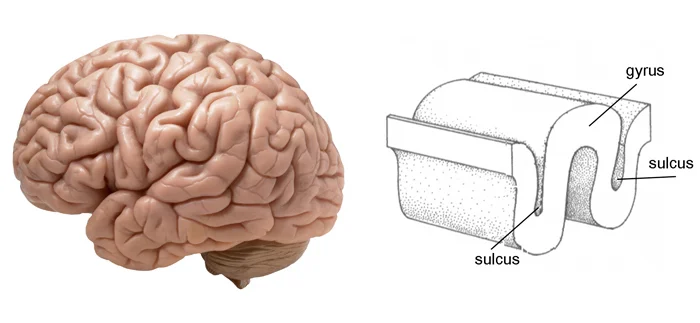
The study sought to investigate the influence of different components of the brain’s physical structure:
- Outer folds of the cerebral cortex, where higher-level brain activity occurs.
- Connectome, a complex network of nerves that links different regions of the cortex
Contrary to prevailing theories, the study revealed that the shape of the outer surface of the cortex was a more significant predictor of brainwave patterns than the connectome itself.
To unravel the mysteries of brain activity, the researchers embarked on an interdisciplinary journey, combining principles from physics, engineering, and neuroscience. Drawing inspiration from the mathematical theory of waves, they explored how neuronal excitation propagates throughout the brain. Like how vibrations travel through various mediums, neuronal excitation can propagate in waves, traversing the convoluted surface of the brain and resonating in periodic oscillations.
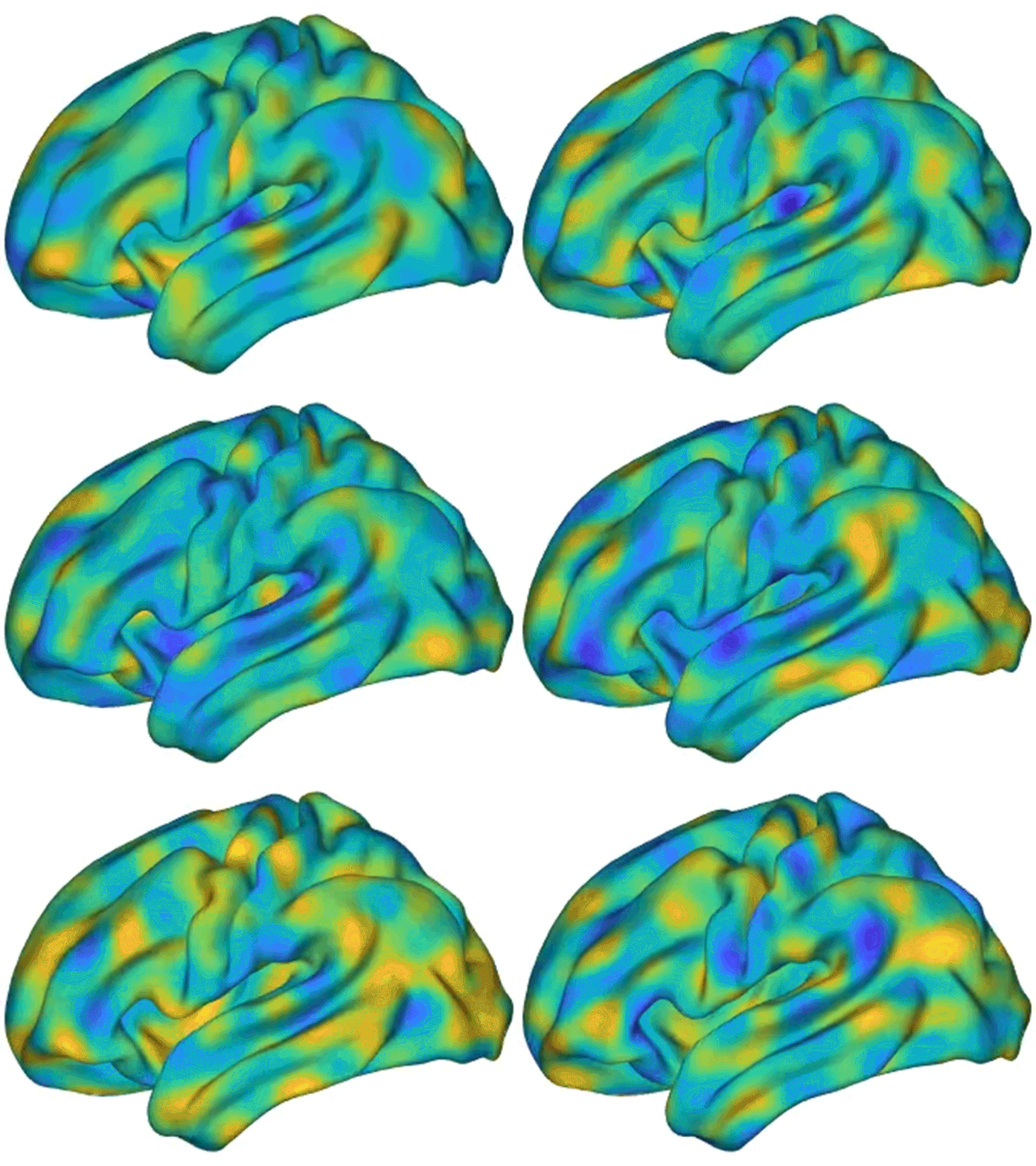
Using mathematical equations to model brainwave propagation on both the cortical surface and the connectome, the researchers made a remarkable discovery. The patterns of brainwaves during rest and various activities, such as visual processing, were better explained by the surface geometry model than by the connectome. This finding challenges the prevailing notion that the connectome is the primary driver of brain activity.
While the study has garnered attention and praise, there are differing opinions within the scientific community. Some experts, such as neuroscientist David Van Essen, have expressed concerns about the limitations of the diffusion magnetic resonance imaging (MRI) data used in the study. Van Essen suggests that examining brain activity in response to simple stimuli that activate specific regions of the cortex would provide a more comprehensive understanding. Nevertheless, the study’s authors view their work as a “proof of principle” and acknowledge the need for further investigation.
It is important to note that the study utilized an idealized model of brain structure, whereas the actual convolutions of the cerebral cortex vary in shape among individuals. Nonetheless, this research provides a promising avenue to explore the impact of these variations on brain activity and its corresponding modes of function.
The implications of this study are profound. Understanding the intricate relationship between brain structure and function is essential for unraveling the mysteries of human cognition and consciousness. The once-perceived peculiarities of the brain—the convolutions—may hold the key to comprehending the complexity of our minds. By delving deeper into the role of cortical folds, scientists may gain valuable insights into neurological conditions and potentially pave the way for innovative therapeutic approaches.
References:
- Pang, J. C., Aquino, K. M., Oldehinkel, M., Robinson, P. A., Fulcher, B. D., Breakspear, M., & Fornito, A. (2023). Geometric constraints on human brain function. Nature, 10.1038/s41586-023-06098-1. Advance online publication. https://doi.org/10.1038/s41586-023-06098-1
- Garcia, K. E., Kroenke, C. D., & Bayly, P. V. (2018). Mechanics of cortical folding: stress, growth and stability. Philosophical transactions of the Royal Society of London. Series B, Biological sciences, 373(1759), 20170321. https://doi.org/10.1098/rstb.2017.0321
- van der Meer, D., Kaufmann, T., Shadrin, A. A., Makowski, C., Frei, O., Roelfs, D., Monereo-Sánchez, J., Linden, D. E. J., Rokicki, J., Alnæs, D., de Leeuw, C., Thompson, W. K., Loughnan, R., Fan, C. C., Westlye, L. T., Andreassen, O. A., & Dale, A. M. (2021). The genetic architecture of human cortical folding. Science advances, 7(51), eabj9446. https://doi.org/10.1126/sciadv.abj9446
Recent Articles

.

.