June 09, 2024
Author: Akshat Garg
Editor: Manish Verma
Machines might not feel…yet but leaps are being made by using AI and other technologies to diagnose depression in animals and humans. Statistically 54.72% of individuals are misdiagnosed with major depressive disorder.1 This is a result due to the subjective nature of diagnoses by the doctors which is prone to bias, culture and even the patient might describe their symptoms inaccurately. This can prove to be catastrophic due to the rapid growth of depression patients in the market, as shown by the graph below.
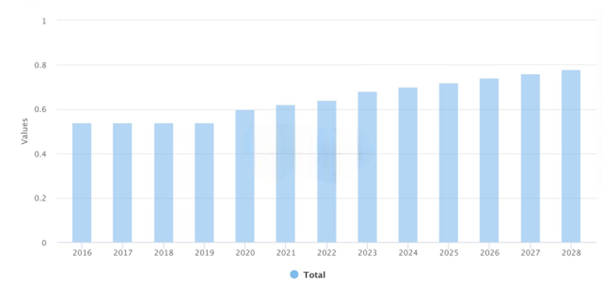
Figure 1: The Patient box shows the number of active paying customers (or accounts) of the selected market in millions for each year.2
Due to this, more reliable and efficient methods for diagnoses are needed. Currently, some plausible candidates for proper diagnoses of depression are EEG and AI.
But how do animals play a role? Well, to develop techniques and/or medicine targeting depression, scientists need to first develop animal models and run tests on the model to then, get their solution approved for a human trial.
Animals play a great deal in understanding various human conditions and are still being researched on to solve various problems including depression.
Since when does a machine have a ‘heart’?
We humans, granted, have highly complex and variable depressive behaviors and machines can’t feel but we are not all that complicated. The recent popular use of AIs such as ChatGPT & MoodCapture has been diagnosing psychiatric conditions in humans. AI can now analyze health records and social media posts, conversations and non-verbal cues to diagnose depression with higher accuracy than doctors.
One study found that ChatGPT could diagnose depression from health records with over 90% accuracy, higher than the average accuracy of a clinical doctor3.
One of the major upsides of depression diagnosis with AI lies within the AI being trained on official guidelines of various countries’ medicine and this results in an absence of malpractice. Doctors have been shown to over-prescribe antidepressants4(Mitchell) whereas ChatGPT strongly suggests talk therapy, in line with various countries’ guidelines. Though it is still nowhere near perfect, AI shows great promise within the realm of diagnosis for the future.
Moreover, some applications have also been trying to crack the code to depression, one prominent example is called MoodCapture. The app accesses the users’ phone’s front camera to monitor their facial expressions and surroundings during regular use, then asses the images for clinical cues for depression.
In a study of 177 people diagnosed with major depressive disorder, the app correctly identified early symptoms of depression with 75% accuracy. The app aims to show the possibility of depression diagnosis done by AI can achieve great accuracy and potentially, 90% in 5 years, making a viable tracker.5
However, there have been more specialized use cases for AI. One of these is the analysis of EEG (electroencephalogram) tests, EEG tests are defined by the Mayo Clinic as “a test that measures electrical activity in the brain using small, metal discs (electrodes) attached to the scalp”. This technique being non-invasive and based on objective analysis rather than the subjective analysis of the patient gives doctors a chance to diagnose their patients with better accuracy and with no harm.
Through various patients’ test, some of the key features of depression patients are the following:8
- Increased frontal beta activity, increased slow waves, and decreased sleep spindles.
- Increased right temporal theta activity and 6/s spike or waves.
- EEG signal slowing down, such as irregular bilateral spikes and positive spikes.
Now, AI is an incredibly powerful tool in pattern detection; due to this, various AI algorithms have been under development to assess the EEG readings automatically to figure out potential patients with depression. This all goes to show the potential eradication of false diagnoses for patients and a step towards better healthcare, and machines are the ones to thank.
How does one diagnose animals?
Though there has been research going on for diagnosing depression through biomarkers and facial expression in animals through AI, the established diagnosis techniques of depression in animals are Forced Swim Test (FST) & Tail Suspension Test (TST) employ rodents to study “depression-like” behavior. The study by Krishnan and Nestler on rodent depression describes the tests-
Forced Swim Test(FST) & Tail Suspension Test (TST
“In the Porsolt test, also known as the FST test, a mouse or rat is placed in an inescapable cylinder of water and, following an initial period of struggling, swimming and climbing, the animal eventually displays a floating or immobile posture. In the TST, immobility is scored while mice are suspended by their tails. Since water is not required, the TST is not confounded by challenges to thermoregulation.”9
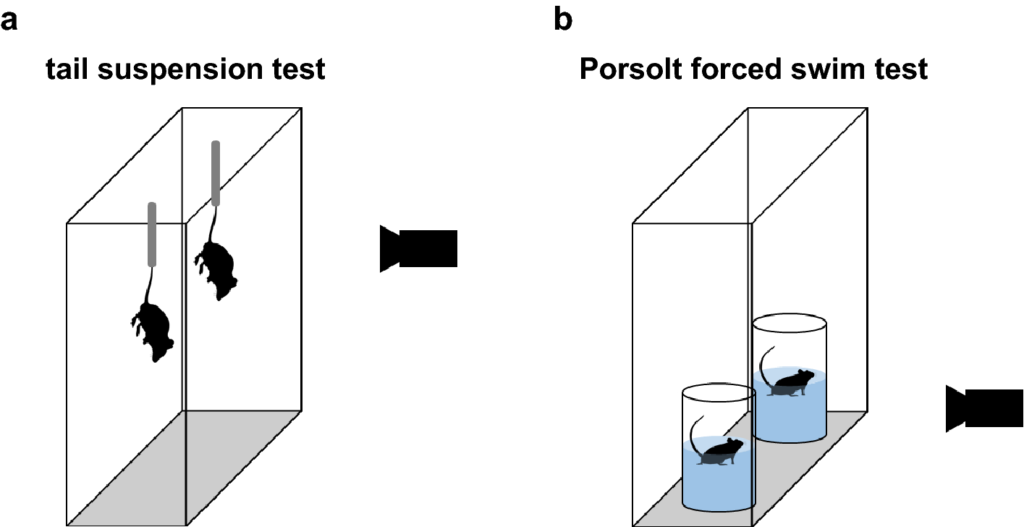
Figure 4: TST & FST10
These tests measure the duration of mobility in rats and immobility or “giving up” by the rodents is assessed as a depressive behaviour.
Technologies like the open-source software DBscorer use technology to automate these tests and increase the reliability of these tests as observer subjectivity is eliminated. Additionally, the software doesn’t just automate analysis but also gives deeper behavioural insights such as latency to immobility, duration of longest immobility bout, and a raster plot showing the evolution of immobility over time. (Nandi et al.) 11
Chronic unpredicted stress (CUS) model
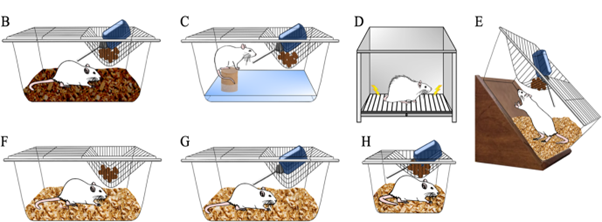
Figure 5: Representations of different stressors in the Chronic Unpredicted Stress (CUS) model in rodents12
However, some models such as the Chronic Unpredicted Stress (CUS) model illustrated above aims to investigate the chronic and heterogenous nature of human depression better than acute tests like FST & TST. This model includes is based off introducing random stressors in an unpredicted pattern to rodents. The diagram above is taken from the article “Behavioral characterization of chronic unpredictable stress based on ethologically relevant paradigms in rats” published in the ‘nature’. The diagram illustrates:
(B) Wet bedding: 300 mL of water was poured on and mixed with 1 L of sawdust bedding. (C) Sleep deprivation: a cylindrical, wooden pedestal (6 cm diameter and 5 cm height) was placed on the floor of the cage opposite to the food/water compartment. The cage was flooded with tap water 3 cm deep, allowing the animal to stand on the bottom of the pedestal but denying the possibility of sleeping.
(D) Electric Foot-shocks: rats were placed in an Ugo Basile Automatic Reflex Conditioner for the administration of 0.8 mA shocks through the grid floor of the chamber. Each 10-minutes session consisted of two trials of 5 minutes with two stages each: the delivery stage with six presentations of 5 shocks interspaced by 30-seconds intervals and the resting stage of 2 minutes in the chamber without receiving shocks.
(E) Cage tilting: the cage was tilted up to 45 degrees with food and water located at the higher top.
(F) Food deprivation.
(G) Water deprivation
(H) Confinement: rats were individually housed in small cages
(20 cm length × 10 cm width × 13 cm height)
By employing this model, researchers study various conditions exhibited by the rodents which are seen as viable symptoms for depressive behaviour.
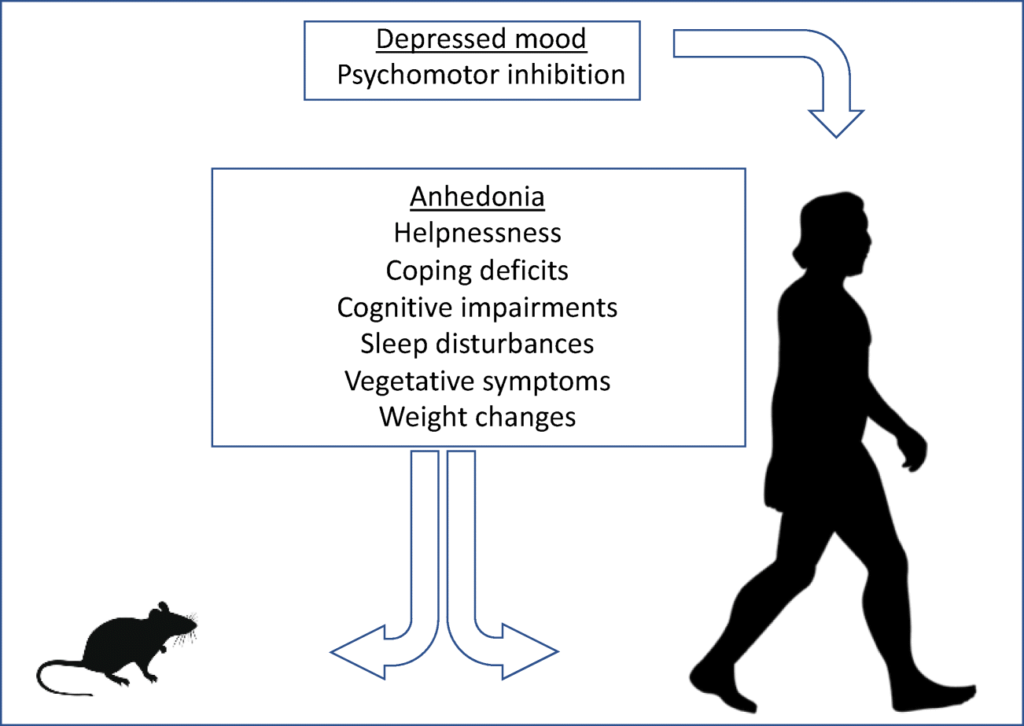
Figure 6: Symptoms of major depression in translational aspect. Major depression is defined by the occurrence of at least one core symptom (underlined) lasting minimally two weeks that is typically accompanied by a number of subsidiary symptoms. Some of these symptoms are purely human phenomena though others can be recapitulated in laboratory rodents, including rats (see the text)13
The model allows the researchers to induce anhedonia (reduced sucrose preference) and other depression-like symptoms. The reversal of the induced depressive behaviors through the use of anti-depressants and stimulants allows researchers to test the effect of various medications on depression and overall health of the subject.
Conclusion
One must keep in consideration that science is an ever-evolving field and there is no 100% accurate method of diagnosing subjective conditions such as Depression. Though, as our population grows, the amount of people requiring mental health care will grow, to tackle this most effectively, there is a need for more studies to be done. That said, scientists are developing newer and improved ways to approach the diagnosis and treatment of various mental health conditions by experimenting with various technologies such as neural networks and biometric trackers. Moreover, with the recent uphaul of AI and ML models, various start-ups and researchers are turning their head towards these models to eliminate human bias and error while also maintaining, if not improving the accuracy of various diagnoses within medicine, including depression. These new techniques, before becoming available to the masses, first are tested on animal models for the scientists to expand their understanding of depressive behaviour; this prompts the testing of improved models and treatment plans without compromising the health of human patients.
References:
- Pmh-C, A. L. L. (2024, April 25). Misdiagnosed with Depression: Signs, impact & next steps to take. ChoosingTherapy.com. https://www.choosingtherapy.com/misdiagnosed-with-depression/
- Statista. (n.d.). Depressive Disorders – Worldwide | Statista market forecast. https://www.statista.com/outlook/hmo/mental-health/depressive-disorders/worldwide#revenue
- Hellewell, S. (n.d.). AI can already diagnose depression better than a doctor and tell you which treatment is best. The Conversation. https://theconversation.com/ai-can-already-diagnose-depression-better-than-a-doctor-and-tell-you-which-treatment-is-best-211420
- Mitchell, P. (n.d.). Are antidepressants over-prescribed in Australia? The Conversation. https://theconversation.com/are-antidepressants-over-prescribed-in-australia-11788
- Phone app uses AI to detect depression from facial cues. (2024, February 27). Dartmouth. https://home.dartmouth.edu/news/2024/02/phone-app-uses-ai-detect-depression-facial-cues
- MSc, O. G. (2023, September 19). EEG procedure. Simply Psychology. https://www.simplypsychology.org/what-is-an-eeg.html
- Ay, B., Yildirim, O., Talo, M., Baloglu, U. B., Aydin, G., Puthankattil, S. D., & Acharya, U. R. (2019). Automated Depression Detection Using Deep Representation and Sequence Learning with EEG Signals. Journal of medical systems, 43(7), 205. https://doi.org/10.1007/s10916-019-1345-y
- Krishnan, V., & Nestler, E. J. (2011). Animal models of depression: molecular perspectives. Current topics in behavioral neurosciences, 7, 121–147. https://doi.org/10.1007/7854_2010_108
- Chen, L., Faas, G., Ferando, I. et al. Novel insights into the behavioral analysis of mice subjected to the forced-swim test. Transl Psychiatry 5, e551 (2015). https://doi.org/10.1038/tp.2015.44
- Nandi, A., Virmani, G., Barve, A., & Marathe, S. (2021). DBscorer: An Open-Source Software for Automated Accurate Analysis of Rodent Behavior in Forced Swim Test and Tail Suspension Test. eNeuro, 8(6), ENEURO.0305-21.2021. https://doi.org/10.1523/ENEURO.0305-21.2021
- Sequeira-Cordero, A., Salas-Bastos, A., Fornaguera, J. et al. Behavioural characterisation of chronic unpredictable stress based on ethologically relevant paradigms in rats. Sci Rep 9, 17403 (2019). https://doi.org/10.1038/s41598-019-53624-1
- trekalova, T., Liu, Y., Kiselev, D., Khairuddin, S., Chiu, J. L. Y., Lam, J., Chan, Y. S., Pavlov, D., Proshin, A., Lesch, K. P., Anthony, D. C., & Lim, L. W. (2022). Chronic mild stress paradigm as a rat model of depression: facts, artifacts, and future perspectives. Psychopharmacology, 239(3), 663–693. https://doi.org/10.1007/s00213-021-05982-w