Author: Harsheen Kaur Vohra
Updated on May 2nd 2022
Have writer’s block? Then get outside and look around. Can’t focus on work? Head outside for a quick walk and breathe. Feeling helpless and burned out? Connect with nature and observe your natural surroundings.
Nature is powerful. Nature heals! Just a dawdle in the natural world or a pause to watch a sunset or listen to birds chirping, gaze at the ocean or mountains, sit in a park, escape to the woods or a nature retreat, or even just spending a few minutes to stare out the window can stimulate the innermost feelings of happiness and peace. We all have observed this ourselves (Figure 1).
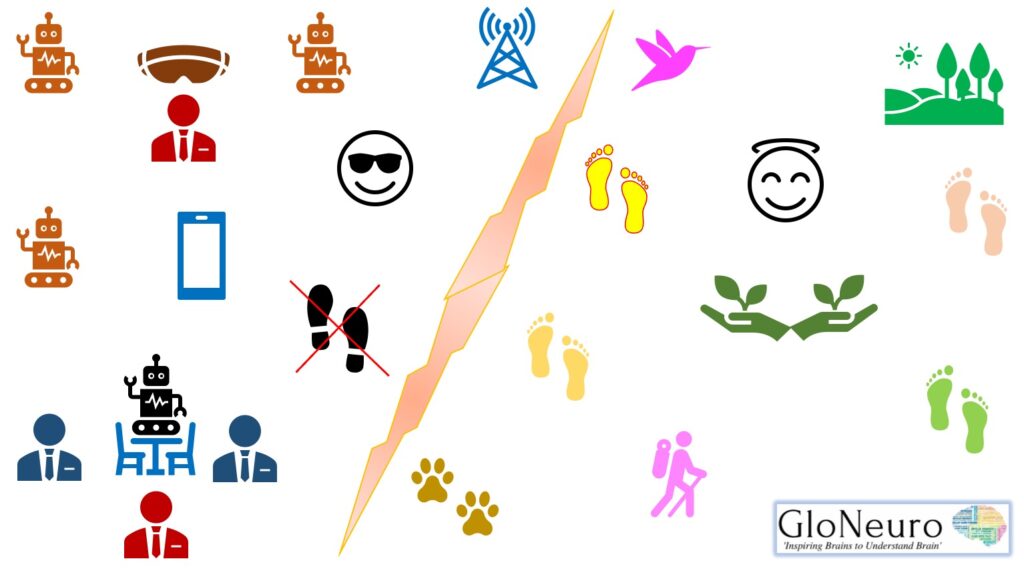
Even in small doses, nature is a potent elixir. Our ancestors grew to understand the natural landscape, figuring out over time how to minimize their ability to secure the factors that sustained life and minimize the multiple threats to it. They grew to respect nature and appreciate the understanding of nature to promote the health of the mind and body. Historically, a remedy for ill health or low spirits, would be to send someone to the quiet side of the country like a seashore and away from the hustle-bustle of the city. Previous research has confirmed that the human race stands to benefit tremendously from nurturing a strong connection with nature, yet we try to escape from nature. We segregate ourselves from the natural environment with cars, houses, shopping malls, technology, and work. Modern life is experiencing less connection with nature; they have been more inclined to a highly stressful environment, workload, and technology addiction that have subsequently distanced humans from nature and its life-giving benefits resulting in physical, emotional and psychological dysfunction, and distress primarily leading to Nature Deficiency.
Nature Deficit Disorder or NDD has become a buzzword of late (Briggs, 2016). “As biological beings, we are physiologically adapted to be in certain environments – to run, to play, to hunt, to be active basically,” as quoted by Dr Cameron. The reality is we tend to have the lifestyle of a brick at the minute. Nature-Deficit Disorder or Vitamin N deficiency is an idea of human beings spending less time outdoors (in nature), resulting in a wide range of behavioural problems, health issues and profound effects on mental health. This disorder is not recognized in ICD-10 or the DSM-5 classification for mental disorders. It’s a symptom of the current lifetime. Richard Louv, author of numerous popular publications and books on nature deficiency including the Last Child in the Woods, the chairman and co-founder of Children and Nature Network coined the term nature-deficit disorder to describe the “human cost of alienation from nature”. He strongly reckoned “The future will belong to those nature smart individuals, families, businesses, and political leaders who develop a deeper understanding of the transformative power of the natural world and who balance the virtual with the real. The more high-tech we become, the more nature we need. He proposed the Nature Principle is “about the power of living in nature—not with it, but in it. Richard also suggests how without regular immersion in nature, humans can suffer physical and emotional distress including anxiety, depression and obesity. The background of his research was initially focused on kids in particular who due to lack of involvement with nature become affected with attention disorders and can be less focused in schools. He also suggests that increasing kids’ exposure to nature-based experiences and education may provide at least a partial remedy for these ills.
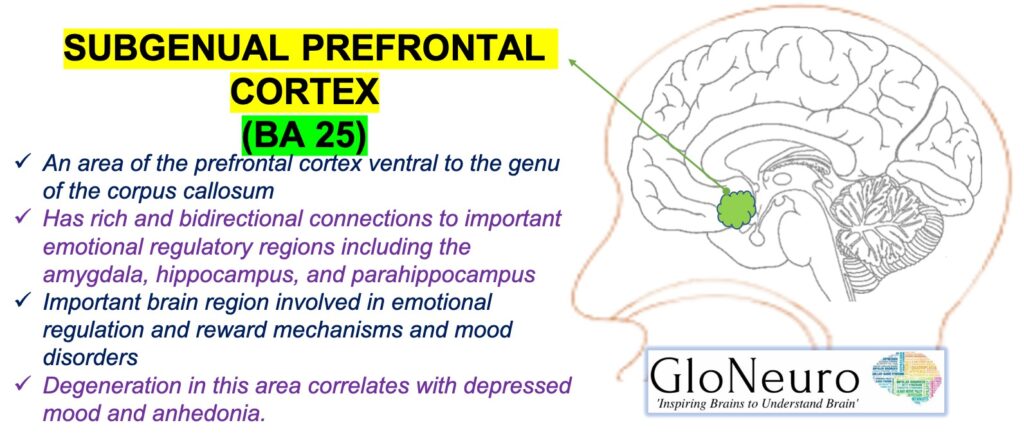
It’s hard to overstate how much good nature does for our well-being. Even a brief walk in nature improves attention, communication, and creativity and acts as an important resource for fostering resilience, by moderating the relationship between stressful life events and mental health. Exposure to nature has additionally shown to soothe the mind and proved to change the working of an individual’s brain. It increases the flow of blood to areas of the brain that are associated with mental illness to treat and is said to improve cognition and memory. A group of researchers from Stanford University put forward their view that simply “being in nature” might have something to do with rumination or a maladaptive pattern of self-referential thoughts that are associated with elevated risk for depression and other mental illnesses. Sadness and worry result in rumination which in turn leads to increased activity in the brain called the subgenual prefrontal cortex; a narrow band in the lower part of the brain that regulates negative emotions. If rumination continues for too long unabated, depression creeps in. Dr Gregory Bratman’s group at Stanford has published a couple of papers following a small group of healthy volunteers told to go for a 5-kilometre walk in the San Francisco Bay area. Half walked along a busy street while the other half went for a scenic walk with beautiful views of the mountains and the bay. The nature walk resulted in decreased anxiety, rumination, and negative feelings, and even increased performance on cognitive tests compared to the walk along a busy street. Later, the same researchers did MRIs and measured blood flow in brain areas of healthy people who went on a 90-minute walk in the same urban vs more natural setting. They found that the nature walkers had reduced activity in a particular brain region, the subgenual prefrontal cortex (Figure 2). This area of the brain is associated with rumination, or worrying about the same issues over and over, a problem described often in depressive and anxiety disorders (Goodstein, 2015, 2017).
Contact with nature, therefore, has a therapeutic and transformative effect. It further highlights the concept of incorporating nature into therapy also known as “nature therapy”, “ecotherapy”, “green exercise”, “green care”, “green therapy” or a more relatable generalized term known as “villaging”. Through nature-based therapy, clients can heal their emotional scars as well as develop a deeper bond with the natural world. A bond that eco-psychologists and eco-therapists believe is essential for one’s emotional wellbeing.
One can gratify in the process of nature therapy by oneself in different ways
- Bring nature into your home environment
· Gather natural materials such as feathers, leaves, seeds, flowers, pots and anything else that would decorate the home
· Create a space in a home from where you can look out over a view of the sky or a tree
· Grow plants on your windowsill.
· Listen to some recordings of natural sounds such as birdsong or waves.
· Offer help to a neighbour with their garden
- Get close to animals
· Go for walks by rivers, fields and trees, and look out for wildlife. Or look out for urban wildlife which is found in your local parks, such as squirrels, fish, insects, ducks and other birds.
· Go to the zoo or any animal care centre
· Think about whether owning a pet would be the right thing for you. Many people find caring for a pet every day brings lots of benefits.
- Do your bit for the environment.
· Plant something outside the front of your home so that everyone who walks by can enjoy it
· Plant flowers for the bees and berry bushes for the birds in your garden.
· Build an animal habitat
- Do more activities outdoors
· Go for a walk in the local park or on the beach
· Enjoy a nature excursion
· If you have a garden, create a space in it that you enjoy sitting in or find a favourite spot in your local park to sit and watch the scenery
· Sit under a tree in silence for a while, lean back against it and feel its support
· If you do regular exercises such as running, jogging, yoga, experiment with doing it in a local park
· Try to walk, run or cycle instead of driving in case of short distance whenever possible
· Go for regular walks alone or with friends
· Give yourself a sensory outdoor workout – find things to look at, listen to, taste, smell and touch
· Take up a new sport
People must now turn to nature to recover, restore and rebalance after the stresses brought on by relentless digital connectivity, workload or everyday stressors; and now this ongoing Covid-19 multiple waves. It is becoming essential for not only living a physically healthy life but also to acing a rollercoaster like world like a mentally strong warrior. It is easy to task nature as the panacea to mental illness, daily hassles and emotionally taxing days.
To conclude, an individual, on a daily basis, faces various stressful situations that threaten to disrupt the life. Today’s working world poses many challenges, people in the working industry often struggle to manage work-home harmony, face work related stress, job loss and unemployment stress, overtime working and pressure in the workplace. Dealing with such adversities, adaptively, requires an individual to be calm, mindful and resilient. Nature walks or barely being outdoors is associated with a whole host of mental health benefits, including decreased depression, improved well-being and mental health, and lower perceived stress.
Now take a deep breath, you read something good again at GloNeuro that is achievable! Look outside your window and if this is the right time, please go out for a stroll.
Reviewer: Medha Tikoo
Illustration(s): Dr. Jitendra Kumar Sinha
Editor: Dr. Shampa Ghosh
References:
Bratman, G. N., Hamilton, J. P., Hahn, K. S., Daily, G. C., & Gross, J. J. (2015). Nature experience reduces rumination and subgenual prefrontal cortex activation. Proceedings of the National Academy of Sciences, 112(28), 8567–8572. https://doi.org/10.1073/pnas.1510459112
Briggs, H. (2016, November 26). Nature deficit disorder explained. BBC News. Retrieved from https://www.bbc.com/news/science-environment-38094186
Goodstein, Eli. “Stanford University Study Says Spending Time in Nature Benefits Mental Health.” USA TODAY College. Stanford University, 09 July 2015. Web. 7 March 2017.
Hill, R. (2017, August 23). How a walk in nature can bring positive changes to body & brain. Retrieved August 1, 2019, from Health Journal website: https://www.thehealthjournals.com/walk-nature-can-bring-positive-changes-body-brain/
Kaplan, R., & Kaplan, S. (1989). The experience of nature: A psychological perspective. Cambridge ; New York: Cambridge University Press.
Kesebir, Selin. (2017, September 20). How modern life became disconnected from nature. Retrieved July 18, 2019, from Greater Good website: https://greatergood.berkeley.edu/article/item/how_modern_life_became_disconnected_from_nature
Louv, R. (n.d.). Home—Richard Louv. Retrieved August 2, 2019, from http://richardlouv.com/
Mayer, F. S., Frantz, C. M., Bruehlman-Senecal, E., & Dolliver, K. (2009). Why is nature beneficial? : The role of connectedness to nature. Environment and Behavior, 41(5), 607–643. https://doi.org/10.1177/0013916508319745
Nature based therapy/ecotherapy. (n.d.). Retrieved August 4, 2019, from https://www.counselling-directory.org.uk/counsellor-articles/nature-based-therapy-ecotherapy
Publishing, H. H. (n.d.). Sour mood getting you down? Get back to nature. Retrieved July 13, 2019, from Harvard Health website: https://www.health.harvard.edu/mind-and-mood/sour-mood-getting-you-down-get-back-to-nature
Reynolds, G. (2015, July 22). How walking in nature changes the brain. Retrieved July 13, 2019, from Well website: https://well.blogs.nytimes.com/2015/07/22/how-nature-changes-the-brain/